The smell that won't quit
It meets you on the stairs — musty, earthy, stronger after rain. Candles and fresheners lose because the source never stops. Guests notice before you do.
— Arvada, Colorado · Basement Mold
Downstairs is where Arvada mold lives: snowmelt pressing on the foundation, sump pumps quitting without a sound, swelling clay cracking the joint where wall meets floor — hidden behind finished drywall. We find the water first, take the growth out, and hand you a lab report.
Musty smell at the top of the stairs? Start with a look and a moisture reading.
01 Below Grade
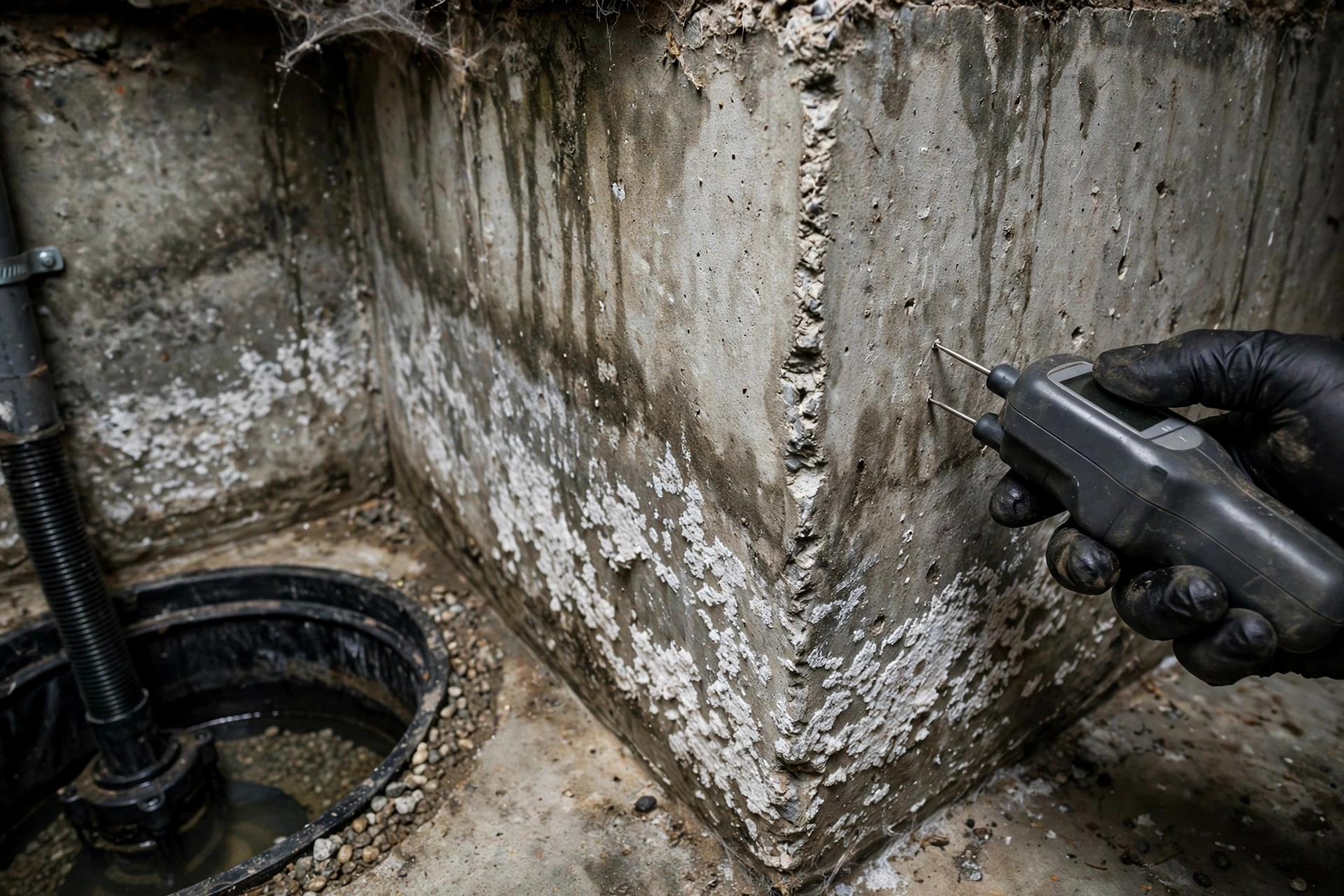
Because the basement is where an Arvada home meets its water — and most of it arrives on a schedule. Snowmelt leans on the foundation for weeks. Clay under the city swells as it wets and pries at the seam where wall meets floor. Pumps wear out quietly in the pit. So every Basement Mold Removal Arvada job we run starts with one question: where is the water getting in? Answer that, and the cleanup holds. Skip it, and the mold becomes a subscription.
The housing stock stacks the odds: the median Arvada home was built in 1979, and 52.5 percent were standing before 1980 — decades of soil movement on the foundation. With 75.3 percent of households owning, the basement is rarely storage: it is the family room, the spare bedroom, the office.
What gets checked on a basement visit:
02 Why People Call
The mold is rarely the first thing people mention — it is what it is doing to the room, the smell, and the house's value.
It meets you on the stairs — musty, earthy, stronger after rain. Candles and fresheners lose because the source never stops. Guests notice before you do.
In Arvada's split-levels and ranches, the basement is not a cellar — it is where the kids play and somebody works. A moldy one is a living-space problem, directly under your bedrooms.
Most basement mold is found late — when a remodel opens a wall, a sale inspection pulls a baseboard. By then the colony has had seasons to spread, and the painted face was never the side that mattered.
One Denver-area appraisal operator reports cutting $30,000 off a home's value over basement water stains and mold odor — one operator's account, not a study, but it shows how buyers read a wet basement — and why documentation matters at sale time.
03 The Mechanism
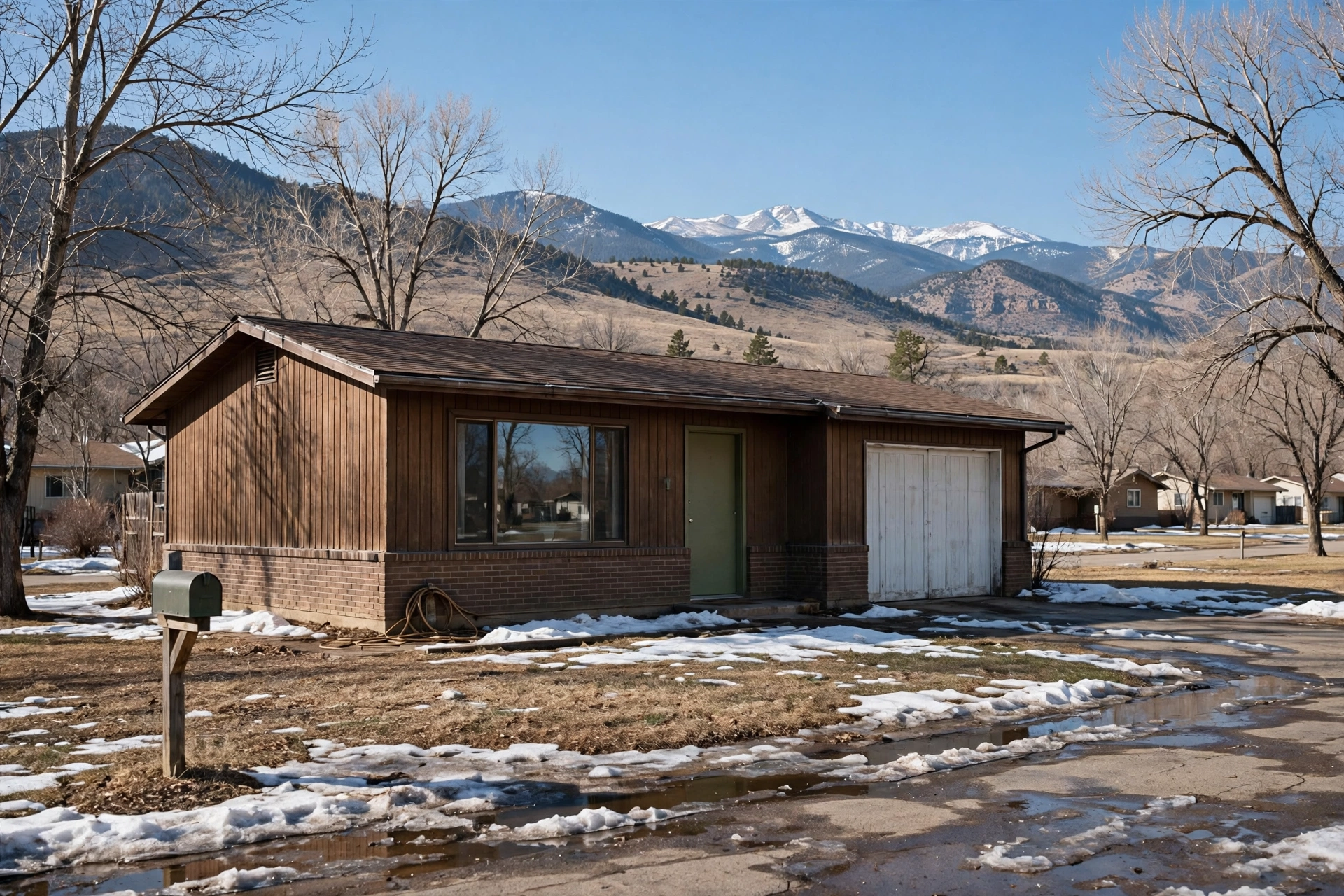
Nearly every basement job traces back to one of four doors. In September 2013 all four swung open at once — Leyden Creek overflowed, Ralston Creek breached the Croke Canal, and 2013 remains Jefferson County's biggest flood-claim year. Even Leyden Rock sits in that same watershed. Most years: one door, one wall, one spring.
The cast rarely changes: snowmelt does the pressing, clay does the prying — Pierre Shale and bentonite the Colorado Geological Survey notes can swell 100 percent or more as it wets, cracking the cove joint first — and the sump pump fails quietly under melt-season duty.
04 The Hidden Half
A finished basement is a near-perfect hiding system: the painted face looks fine, but the paper backing is mold food, the insulation holds moisture like a sponge, and carpet pad stays damp. A wall can be colonized edge to edge and still look clean from the doorway.
That is why we never quote basement work from the doorway. Moisture-meter mapping and base-plate checks — plus a small inspection opening where readings demand it — show the extent before the scope is written — the number you approve is built on what is actually back there.
The good news: framing behind that drywall usually survives — HEPA-vacuumed, treated, kept. Only the porous finishes come out, only where mapping shows colonization.
05 How We Work
Every Basement Mold Removal Arvada project follows the same order, because the order is the whole point: no cleanup outruns a live leak, and nothing counts until a lab says so.
Meter readings, the water pathway traced, the extent marked — before anything opens or is priced.
Dead pump replaced, grading corrected, leak repaired, joint addressed — a written line in the scope, not an afterthought.
The area is sealed under negative air with HEPA filtration, so opening the wall does not seed spores into clean rooms.
Colonized drywall, insulation and carpet come out, bagged for disposal. The framing stays — HEPA-vacuumed and treated.
Air scrubbers wash the space, surfaces HEPA-vacuumed again, materials dried to standard — the pass that decides whether this stays one-time.
Clearance testing by a third-party lab where testing applies, plus a written report. The finish line is a lab result, not our opinion.
06 Who Calls Us
Calls for Basement Mold Removal Arvada work tend to come through four doors — fittingly, the same number as the water.
In Lake Arbor and Club Crest, 1970s and 80s split-levels put bedrooms and the family room downstairs. When it smells, it is not a corner you can close off — it is where everybody sleeps.
The oldest foundations in the city — Olde Town, the postwar ranches — and in West Woods, 1990s builds whose pumps and seals are aging into the same problems. Decades of soil movement; a basement finished after the house went up.
Colorado's seller disclosure (Form SPD19) asks about basement moisture and mold reports. A documented job with lab results is the cleanest answer a seller can hand a buyer — and buyers who spot stains call us to price the truth.
A tenant's mold report starts SB 24-094's 72-hour clock to begin containment and stop the water. We work to that clock — and the documentation (scope, photos, lab results) is built to be shown.
07 Cost, In Writing
Published figures, labelled sources, your real number in a written scope before work starts — not a ballpark that doubles when the wall opens.
| Service | Typical Range | Source |
|---|---|---|
| Typical Arvada remediation job | $1,600–$2,900 | Local published range |
| Larger, multi-area remediation | $1,500–$4,500 | Atlas Contracting & Environmental — published range |
| Mold inspection | $250–$500 | Local published range |
| National average remediation job | $2,368 | Angi — national average, not an Arvada price |
Every job starts with a written, itemized scope you approve before any plastic goes up.
08 Get Started
Request Inspection Online
Tell us what you are seeing — the smell, the stain, the flooded corner. We will call back with next steps.
Prefer to talk? Call (720) 794-0650.
09 FAQ
Published local figures put a typical Arvada job at $1,600–$2,900 and larger jobs at $1,500–$4,500 — a whole finished basement sits toward the larger end, a single wall toward the smaller. Angi's national average is $2,368 — national, not a local quote. Your number comes from the written, itemized scope after assessment, fixed once work starts.
Because mold is the symptom and water is the disease. If the seepage, dead pump or cracked joint that fed the first colony still feeds the wall, a new colony follows — within a season, sometimes. Our scopes fix the source as part of the job, and confirm with lab testing, not eyesight.
Usually behind the finished wall, under the carpet pad, or along the cove joint where wall meets floor — places air reaches but eyes do not. A musty smell is mold's exhaust; in a basement it almost always means a colony out of sight. A moisture-meter pass finds the wet area first.
Only the sections that are colonized — mapped before anything opens, so the opening is surgical, not exploratory. Drywall, insulation and carpet with mold growing through them cannot be cleaned in place; the framing behind them usually can. Containment goes up first, so the rest of the house stays clean.
Check the pit after a wet week: a pump that cycles constantly, runs rough, or sits in water it cannot clear is telling you something. Pumps also age out — quietly, in the season you need them most. On a visit we check the pit, cycle and discharge line; a failing pump goes in the scope as a replacement.
Sometimes. A sudden event — a burst pipe, a failed water heater — is the strongest case; slow seepage is usually treated as maintenance and denied. Know two things: mold coverage is commonly capped, typically $1,000 to $10,000, and sump failure usually needs a separate water-backup endorsement. Photograph everything before cleanup; our report is built to support the claim.
The smell, the stain, the flooded corner — whatever brought you here, the next step is a look, a moisture reading, and a written scope you can hold us to.
Free, no-obligation quotes · Written scope before work starts · Third-party lab clearance