Mold Removal
The physical take-out: colonized drywall, insulation and carpet removed under containment, framing HEPA-vacuumed and treated — never fogged over or painted shut.
— Lakewood, Colorado · Mold Remediation
Lakewood sits southwest of our Marshall Street base, and a job there runs exactly the way a job at home does: we find the water first, contain the work area, take the growth out, and hand you a lab report at the end. From the postwar streets around Belmar to the blocks climbing toward Green Mountain on the west side, the mold story is the regional one — snowmelt, swelling clay soil, and finished basements that hide what the water is doing.
Smell something musty, or found a stain that keeps spreading? Call and describe it — we will tell you straight what it usually means and what a look usually involves.
01 Our Services
Thirteen ways in, one standard of work — and together they are what mold remediation Lakewood homeowners are actually hiring: not a fogging, but the moisture source found, the growth removed under containment, and the result verified by a lab that does not work for us.
The physical take-out: colonized drywall, insulation and carpet removed under containment, framing HEPA-vacuumed and treated — never fogged over or painted shut.
The complete protocol around the removal: moisture source found and fixed, containment, air scrubbing, drying, and a clearance test at the end.
Air and surface samples read by an accredited third-party lab, with the full report in your hands — useful for home sales, disputes and final clearance.
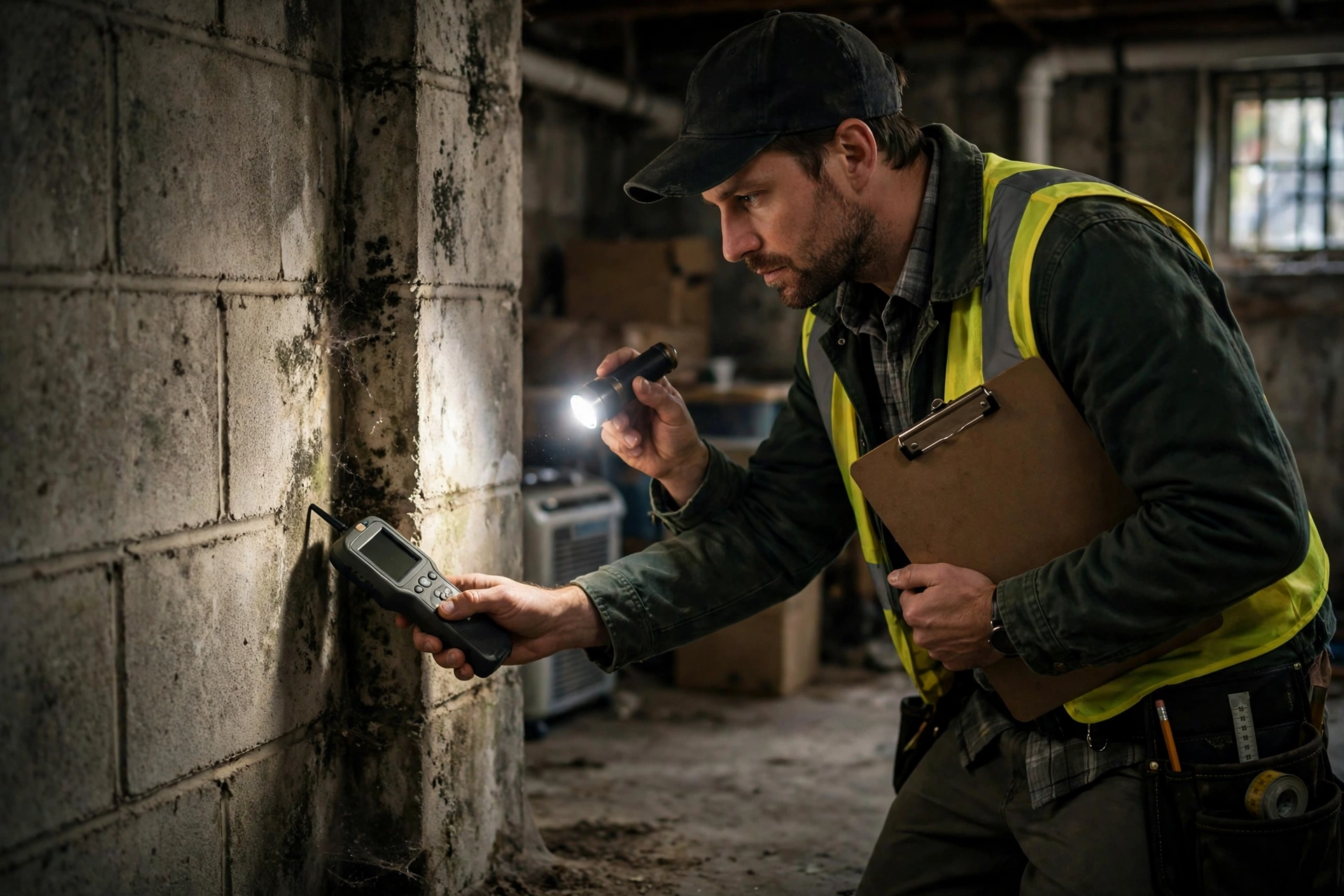
A moisture-first inspection: meters on the wall, the full pathway of the water traced, and written findings with a scope any contractor can be held to.
Real published ranges for Arvada jobs, what actually moves the price, and how to read a quote line by line before you sign one.
Dark growth on chronically wet drywall usually means a long-running leak. Stricter containment, the same S520 process — and no scare tactics.
Burst pipe, flood or sewage backup? The mold clock starts within 24–48 hours of the water. Call now and we will tell you what to do first.
Growth on sheathing and framing from roof leaks, ice dams and bath fans vented into the attic — treated and dried, ventilation corrected.
Our most common Arvada call: snowmelt seepage, dead sump pumps and clay-soil foundation cracks, hiding inside finished basement walls.
Growth on joists and subfloor, fallen insulation replaced, vapor barrier repaired, and the ground-moisture source fixed.
Contamination at the coil, drain pan, air handler and duct lining, assessed as clean-versus-replace — not sold as a generic duct cleaning.
Post-leak, post-flood response: rapid drying inside the 24–48-hour window, then remediation of whatever managed to colonize.
The same protocol at building scale: tenant coordination, after-hours work, and the documentation managers and insurers need.
02 Why Lakewood
Lakewood is Jefferson County's largest city, and much of its housing is postwar and 1970s–80s suburban stock — the same broad era pattern we work in Arvada, and the era that finished its basements and took the quick route on bath-fan venting. It also shares Arvada's weather: snow that arrives in storms and leaves in pulses, with spring meltwater pressing hydrostatically against foundation walls for weeks at a time.
Underneath sits the same soil problem. The bentonite and Pierre Shale clays along the Front Range can swell 100 percent or more as they wet, per the Colorado Geological Survey — the heave cracks foundations and opens the cove joint where wall meets floor, and meltwater follows the opening. Add a sump pump that burns out under melt-season duty, and a finished basement can stay quietly wet behind drywall for a whole season before a smell or a stain gives it away.
That is the pattern behind most mold remediation Lakewood calls we run: the living areas look fine, and the problem has been growing below grade. Often the first clue is not a stain at all — it is a musty smell that will not quit, which is why we wrote our guide to a musty smell with no visible mold: where that smell usually comes from, and how we track it back to its source.
03 The Hard Parts
The mold itself is usually the easy part. These are the four things that actually make the job hard:
One company quotes a number over the phone, another wants to open walls before it will price anything. Without a written, itemized scope, there is no way to tell a fair quote from a padded one — and “am I being overcharged?” is the first question we hear on most calls.
A scrubbed wall looks fixed for a month. Then the smell returns, because bleach and elbow grease lighten the surface while the growth stays in the porous material — and the water feeding it never got fixed. Recurrence after a DIY attempt is the most common reason a small job becomes a bigger one.
Paint and drywall hide the whole story. By the time a finished basement wall bubbles or stains, the colony behind it has usually been established for a while — which is why our inspections start with a moisture meter, not a glance.
A plumber? A testing company? A cleanup crew? When people search for mold remediation Lakewood help at midnight, half the results are national call centers, and many of the rest are companies that test and remediate — and grade their own homework. The honest order is: find the moisture, get a written scope, and keep the lab independent.
04 Who Calls Us
Your stock is the region's mold stock: finished basements, era venting shortcuts, and foundations that have taken decades of snowmelt cycles. A moisture-first inspection tells you which of those is feeding your problem.
An inspector finds growth, and suddenly a closing is a negotiation. Colorado's seller disclosure (Form SPD19) asks about moisture and mold reports directly — a written scope and third-party clearance results are the paper that settles the argument.
Under Colorado's SB 24-094, a tenant's mold notice starts a 72-hour clock. A documented response — dated photos, a written scope, lab results — is what shows you acted, and acted on the real problem.
No scare tactics, and no species-of-the-week. You get a moisture reading, a written scope you can hold us to, and a lab report at the end. That is what mold remediation Lakewood families should expect from anyone — ask us, and ask the next company too.
05 Get Started
Request Inspection Online
Tell us what you are seeing — the smell, the stain, the flooded corner. We will call back with next steps.
Prefer to talk? Call (720) 794-0650.
06 FAQ
The questions Lakewood homeowners ask us first — answered the way we answer them at the kitchen table.
You get us. We are based at 5220 Marshall St in Arvada, Lakewood is southwest of us in the same Jefferson County run, and it is one of our regular service areas — same crew, same written-scope process, same third-party lab clearance at the end of the job.
Start with published numbers, not a guess: local published ranges put a typical job at $1,600–$2,900, with larger published jobs running $1,500–$4,500, and inspections published at $250–$500. For context, Angi's national average is $2,368 — a national figure, not a Lakewood quote. With us, the number you approve is a written, itemized scope before any work begins.
Because the water keeps showing up. Spring snowmelt presses against foundation walls for weeks, Front Range clay soils swell as they wet and crack the joints that water follows, and sump pumps quit under melt-season load. A finished basement hides all of it behind drywall — remediate the growth without fixing the water pathway, and it returns.
No — Colorado does not license mold remediators, and CDPHE states plainly that it does not regulate mold. There is also no EPA certification for mold companies, whatever a website claims. What exists is a standard process, ANSI/IICRC S520: containment, removal, air scrubbing, and clearance. Judge any company — us included — on checkable things: a written scope, that process, and independent lab results.
For a small, contained job, usually yes — we seal the work area off from the rest of the home either way. For larger jobs or confirmed black mold, 24 to 48 hours away is often the sensible call, especially with kids, older adults, or anyone with breathing issues. We will tell you honestly which side of that line your job falls on before work starts.
The smell, the stain, the flooded corner — whatever brought you here, the next step is a look, a moisture reading, and a written scope you can hold us to.
Free, no-obligation quotes · Written scope before work starts · Third-party lab clearance