The complaint that sat too long
A tenant mentions a smell in March. By May it is a written notice and a story about a landlord who ignored it. The expensive part is rarely the growth — it is the gap between the first report and the first response.
— Arvada, Colorado · Rentals, Retail & Workplaces
In a home, mold is a cleanup. In a rental or a workplace it is also a deadline and a paper trail. Commercial Mold Remediation Arvada is our building-scale version of the same S520 process — containment up fast, tenants kept informed, doors kept open where safe, and every step documented.
Start with a walk-through and a written scope.
01 The Building Version
More than a bigger residential job. When owners and managers come to us for Commercial Mold Remediation Arvada, the growth is the easy part to explain. Everything around it needs managing: a tenant who reported the problem in writing, a shop that cannot close for a week, an insurer asking for readings and dates. The work follows our home sequence — assess, contain, remove, dry, confirm — at building scale, written down at every step.
And the same honesty we give homeowners: Colorado does not license mold remediators, CDPHE does not regulate mold, and no EPA certification exists. On a commercial job the checkable things matter more, not less.
02 Why Buildings Call
The growth is biology. The trouble it causes a building is administrative — clocks, leases, and people asking for proof.
A tenant mentions a smell in March. By May it is a written notice and a story about a landlord who ignored it. The expensive part is rarely the growth — it is the gap between the first report and the first response.
Shut it down and clear everyone out is sometimes right — and often lazy. A contained zone under negative air is a sealed room, not a closed building: phased properly, the building keeps running while one zone is remediated. We will tell you when closing is the safe call.
Six months after a job, the questions arrive: the insurer wants moisture readings, the buyer wants the clearance report, a tenant's lawyer wants dates. If the file holds only a paid invoice, you are answering from memory.
03 The Legal Clock
Colorado's habitability law — SB 24-094 (C.R.S. §38-12-503(12), in force since May 3, 2024) — sets the timeline for residential rentals. When a tenant gives written notice of mold connected to dampness, the first duties are fast: within 72 hours, containment started, the water source stopped, HEPA air filtration running. Then come the follow-through steps — drying, removal, and post-remediation testing to confirm the space is back to standard — documented as it happens.
The statute speaks to residential rentals — homes and apartments. A retail or office lease writes its own rules, and most put the building systems on the owner. This page is general information, not legal advice. We run the response the law describes, on its clock, and paper it.
04 How We Work
This is the sequence every Commercial Mold Remediation Arvada job follows — planned around your tenants, your hours, and your file.
We walk the building, meter the walls, and photograph everything. The visit produces the itemized scope — and the first dated entries in your pack.
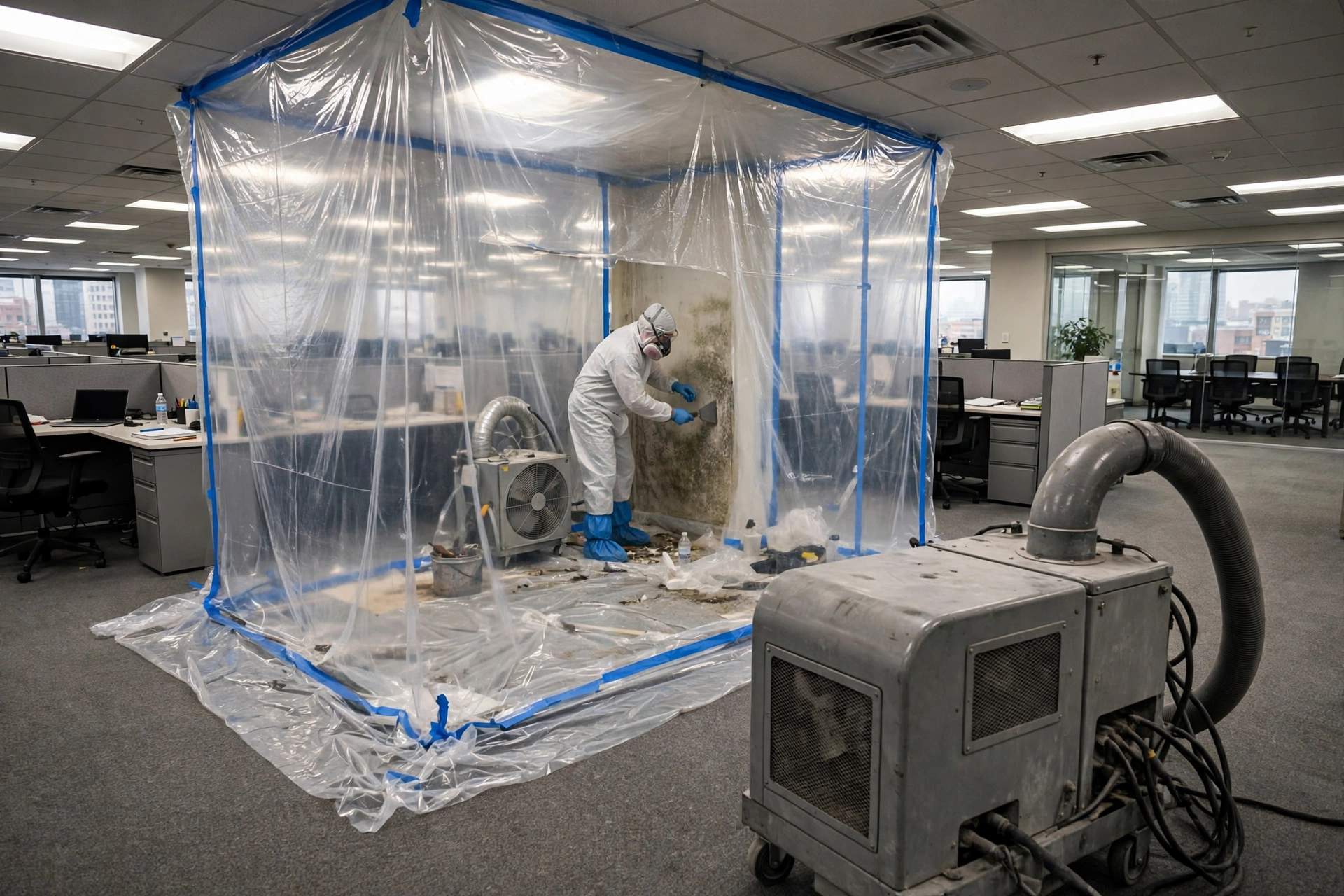
The work zone is sealed under negative air with HEPA filtration — set up after hours in occupied buildings, so tenants never walk through it.
Colonized drywall, insulation, and finishes come out inside containment, bagged on site. Structural material is HEPA-vacuumed and treated.
The structure is dried to standard, verified by meter, while HEPA scrubbers wash the air.
Independent lab testing — never read in-house — confirms the space is back to normal before containment comes down.
You receive the full file: scope, dated photos, moisture readings, lab reports, and a summary letter.
05 Who Calls Us
Most Commercial Mold Remediation Arvada calls come from one of four chairs — each with its own deadline.
You hold a tenant's written notice and a 72-hour clock: the response started, the statute's steps done, a file that proves the dates. One call starts both.
Square footage and business hours: a stockroom wall, a restroom chase, a suite that smells wrong. The work gets zoned so the register keeps ringing — containment after close, removal in phases, clearance before reopening.
A buyer's inspector found growth, and it has become a price chip in somebody else's negotiation. A documented remediation — scope, photos, lab clearance — turns it into a closed line item.
You answer to an owner, a budget, and a building full of occupants. You need scopes you can forward up the chain and records your file can use.
06 Cost, In Writing
Honestly: nobody can price a building off a webpage. A stockroom wall and a flooded multi-tenant floor share a trade name and nothing else. The $1,600–$2,900 range on our homepage describes a typical house; it does not transfer to a building.
An inspection first, then a written, itemized quote for your scope — phased quotes when a building needs stages. The number you approve is the number you pay.
07 The Local Picture
Our Commercial Mold Remediation Arvada work concentrates where the city's commercial buildings are oldest. In Olde Town, early-1900s brick storefronts along Grandview Avenue and Olde Wadsworth sit over below-grade storage that floods quietly. Along the Marshall Street corridor, light industrial and warehouse buildings pair flat roofs with rooftop units, and leaks come from above, into ceiling tiles. The Ralston Road corridor adds older strip retail: long-tenured tenants, aging plumbing, restrooms damp for a decade.
The water behaves the way it does in Arvada houses — snowmelt against foundations, bentonite clay, sump pumps quitting in melt week — but the stakes wear a suit: tenants and a paper trail. If something smells musty, the cheap day to look is today.
08 Get Started
Request Inspection Online
Tell us what you are seeing — the smell, the stain, the flooded corner. We will call back with next steps.
Prefer to talk? Call (720) 794-0650.
09 FAQ
Treat it as the start of a legal clock, not a maintenance ticket. Under SB 24-094, containment, stopping the water source, and HEPA filtration are due within 72 hours. Call us, keep the notice and every date, and do not paint over the growth first.
The statute — C.R.S. §38-12-503(12), in force since May 3, 2024 — sits in Colorado's residential habitability law, so it covers rental homes and apartments directly. Retail and office leases set their own duties; most put building systems on the owner. Either way, a documented, dated response is the protection. (General information, not legal advice.)
Often, yes. A contained zone under negative air is a sealed room, not a closed building, and we set up after hours so unaffected areas keep operating. When growth sits in occupied breathing space or the HVAC, a partial closure may be the safe call — we will say so in the scope.
Per written scope, after an inspection — buildings vary too widely for a published range to mean anything. Your quote is built from the area under containment, after-hours needs, tenant spaces involved, and what has to come out. The number you approve is the number you pay.
A documentation pack: the itemized scope, dated photos, moisture readings, the third-party lab clearance report, and a summary letter for a tenant, an insurer, or a buyer's inspector. It answers questions six months later.
There is no such license: Colorado does not license mold remediators, CDPHE states that it does not regulate mold, and no EPA certification exists. Judge any company on checkable things: the S520 process, a written scope, and independent lab clearance.
The smell, the stain, the flooded corner — whatever brought you here, the next step is a look, a moisture reading, and a written scope you can hold us to.
Free, no-obligation quotes · Written scope before work starts · Third-party lab clearance