The Tester Sells the Cure
The company running your test also sells the cleanup — and, surprise, the test always finds a big, expensive problem. When a firm profits from a scary result, you are right to wonder about it.
— Arvada, Colorado · Mold Testing & Lab Reports
A mold test is only worth paying for when the answer changes a decision — a purchase, a dispute, or proof a cleanup worked. We collect air and surface samples, an independent lab reads them, and the full report lands in your hands with a plain-English walkthrough.
Not sure a test is worth it? Call and describe what you are seeing — we will tell you straight, even if the answer is "save your money."
01 Before You Pay for Samples
Sometimes — and often not. If you can see growth on a basement wall, a lab report naming the species changes nothing: the material still has to come out, and the water feeding it still has to be fixed. Testing earns its money when a document has to exist — when a buyer, seller, tenant or insurer needs the answer in writing from a lab with nothing riding on the result.
That is the spirit behind the mold testing Arvada homeowners get from us: samples collected properly, read by an independent lab we do not own, and explained line by line when the report lands.
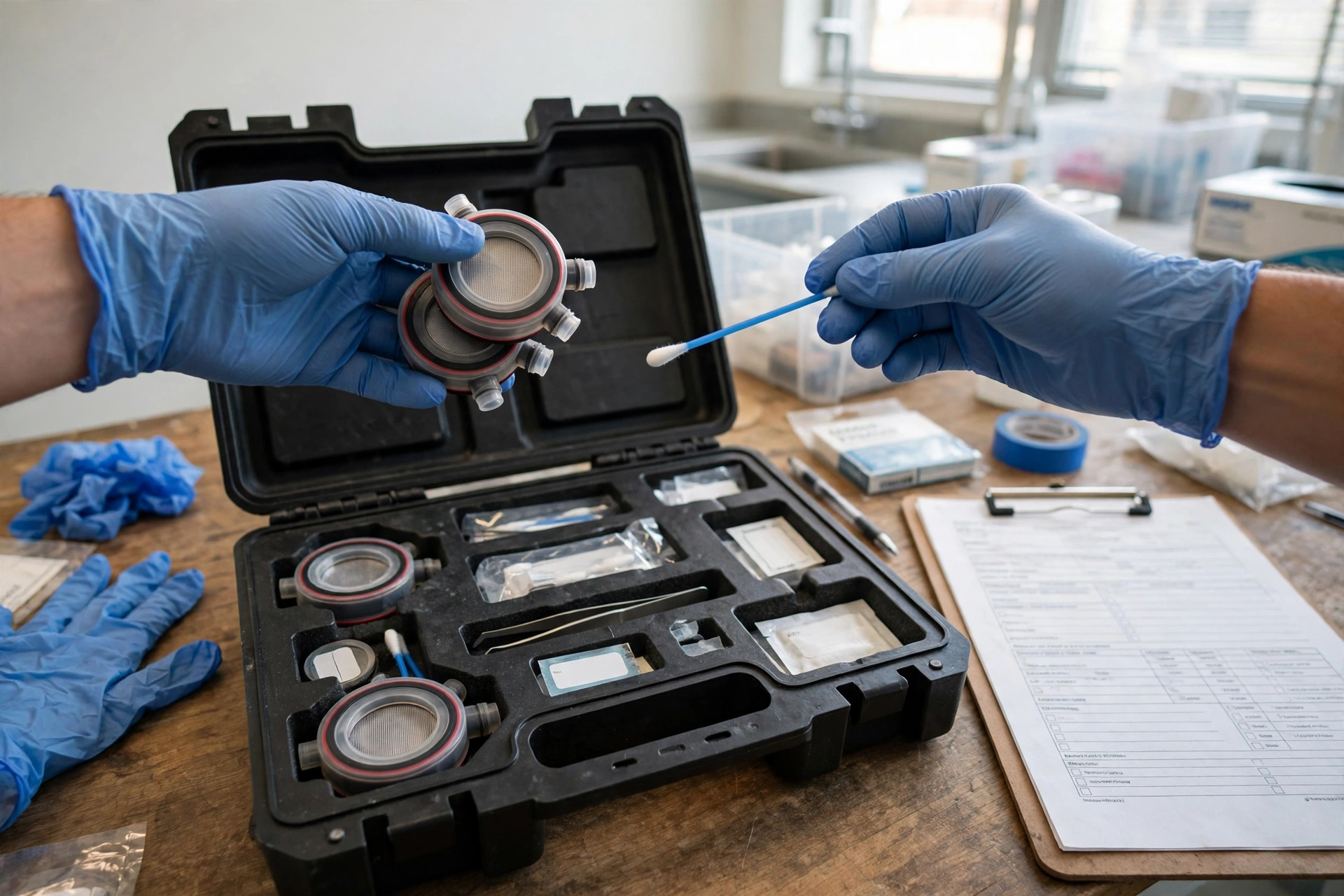
One thing, said plainly: we are a remediation company. We clean up mold — we are not an independent testing firm, and we will never dress ourselves up as one. We collect samples properly, send them to a third-party lab, hand you the unedited report, and tell you honestly when a test adds nothing but cost.
02 The Trust Problem
Most testing horror stories we hear across Arvada kitchen tables share the same shapes:
The company running your test also sells the cleanup — and, surprise, the test always finds a big, expensive problem. When a firm profits from a scary result, you are right to wonder about it.
Petri-dish kits grow mold from any home's air, because every home's air carries spores. A fuzzy dish proves your house has air. It cannot say how much, what kind, or whether it is more than what's outside.
A report lands in your inbox: a spore count, nothing else. Is that bad? Compared to what? Without the outdoor baseline from the same day, a raw count is a number looking for a meaning.
When a report has to survive a negotiation or a dispute, "someone's meter said so" is not enough. You need logged samples and a lab's letterhead, gathered before the arguing starts.
03 Worth It, or Not
Of the four, clearance is the one homeowners lean on hardest: it proves a negative — the finished room's air back to normal background, in writing, from a lab with no cleanup to sell.
What it costs: published local ranges put professional inspection and testing in Arvada at $250–$500. One Arvada homeowner's published review reported $250 for an inspection including two third-party lab samples — one review, not a price list, but a fair marker for the low end. We quote your plan in writing before anyone opens a cassette.
04 How It Works
Four steps, and only one of them wears a lab coat:
Notice who is missing from step two: us. The lab does no cleanup work and has never seen your quote. That distance is not a detail — it is the entire point of paying for a test.
05 Reading the Report
Start with the outdoor sample. Every testing day begins with a control cassette run outside, because Colorado air is never spore-free — a breezy April afternoon in Arvada carries plenty. Indoor results only mean something beside that same-day baseline; a report without an outdoor control is missing its yardstick.
Read it as a comparison, not a score: indoors should generally sit at or below the outdoor level, with a similar mix of types. The real red flag is not a big number — it is indoor counts of water-loving types that barely register outdoors. That pattern points to a moisture source inside the house.
And treat any single "safe" or "unsafe" line with suspicion: no official pass–fail spore number for homes exists, and a report that prints one is printing an opinion. A good report gives you types, counts, and the indoor–outdoor comparison — enough for a decision.
06 Who Needs the Paper
Your inspector found staining or a musty basement in a Lake Arbor split-level, and your inspection window is ticking. A lab report turns "smells damp" into documented findings to negotiate with — or walk away on.
Colorado's disclosure form asks directly about moisture, seepage and mold reports. Testing before you list — and fixing what it finds — beats explaining a buyer's surprise mid-contract.
A tenant reports mold, Colorado's SB 24-094 starts a 72-hour clock, and the follow-through must be documented. A third-party lab report is the paper trail showing you acted — and what you acted on.
We cannot tell you what mold is doing to anyone's health — that is a doctor's call, and anyone who says otherwise is selling. A test can confirm whether a hidden source is feeding the air your family breathes, so the worry gets a factual answer.
07 Get Started
Request Inspection Online
Tell us what you are seeing — the smell, the stain, the flooded corner. We will call back with next steps.
Prefer to talk? Call (720) 794-0650.
08 FAQ
The questions we hear most about the mold testing Arvada homeowners are weighing up — answered short, straight, and with the reasoning attached.
Usually, no. Visible growth has to be contained and removed whatever species it is, and the moisture source fixed either way — a lab name changes none of that. Spend it at the end instead, on clearance samples that prove the cleanup worked.
As a curiosity, maybe; as evidence, no. Settle-plate kits grow mold from any home's air — every home carries spores — so a fuzzy dish is expected, not a diagnosis. They cannot count spores or compare indoor air against the outdoor baseline, which is where the real answer lives.
An independent third-party lab — not us, not anyone who sells cleanup. We collect the cassettes and swabs, log and ship them; the lab reads them and issues the report. You get the complete report, unedited, and we walk through it with you line by line.
Published local ranges put professional inspection and testing at $250–$500. One Arvada homeowner's published review reported $250 for an inspection including two third-party lab samples — one review, not a guarantee, but a fair marker for the low end. Before we collect anything, you get the plan and price in writing.
It compares air in the finished work area against the outdoor baseline from the same day. When indoor levels come back at or below it, with no water-loving types standing out, the lab confirms the space is back to normal background — the written finish line of a job, issued by the lab, not the crew.
A lab report can name the types present and how their levels compare with outdoors. What they mean for one person's health varies, and that judgment belongs to your doctor — we will not pretend a spore count is a diagnosis. What we can do is find and remove the source feeding them: the part of the problem that can be fixed.
The smell, the stain, the flooded corner — whatever brought you here, the next step is a look, a moisture reading, and a written scope you can hold us to.
Free, no-obligation quotes · Written scope before work starts · Third-party lab clearance