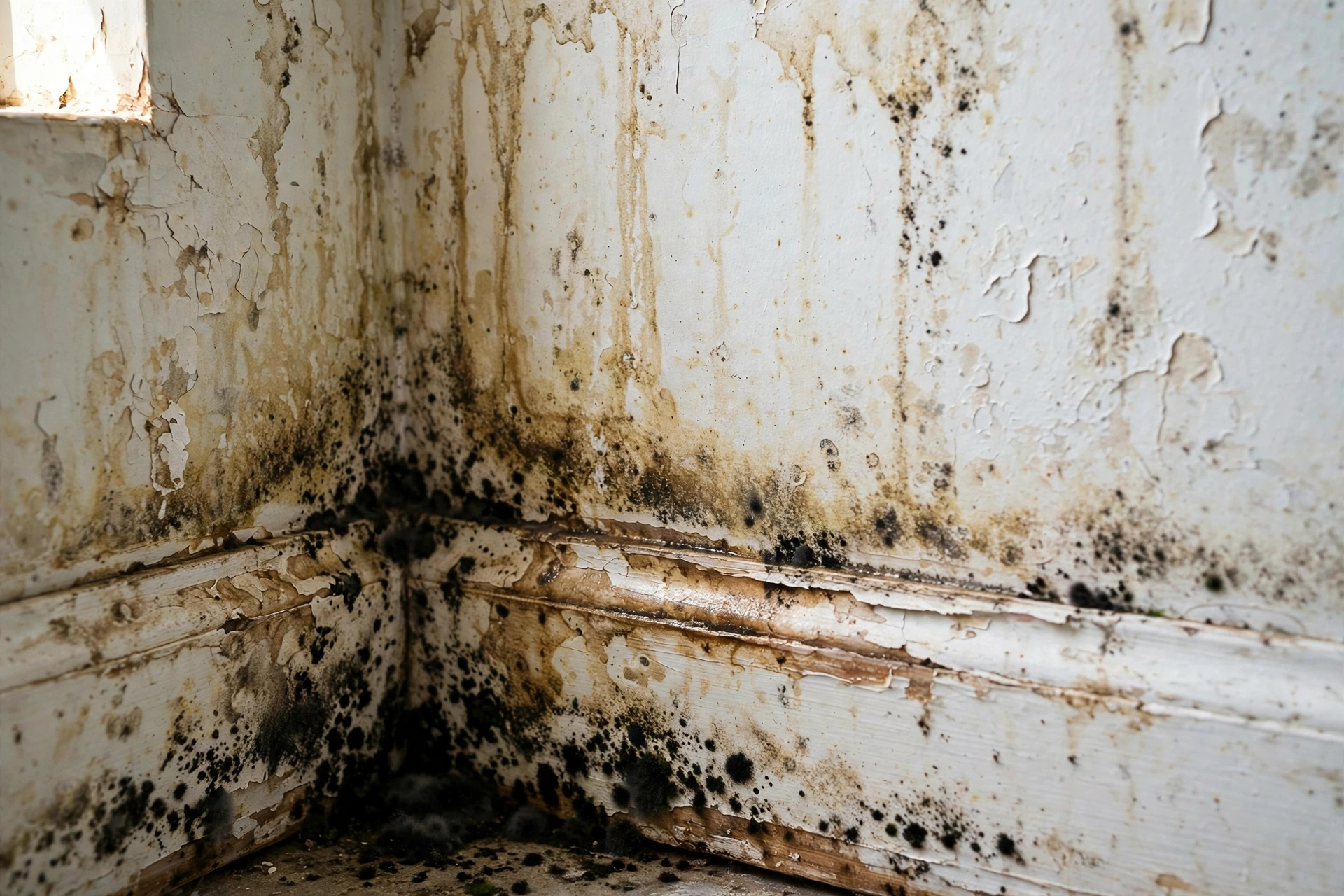
A dark patch on the basement wall ruins anyone's week — because nobody can tell you what it is. We can: test it, name it, contain it, remove it under the S520 process, and hand you a lab result at the end. No scare tactics, no guessing, no painting over it.
Talk to a mold specialist now — or, if you would rather we call you, request an inspection online and we will come to you.
ANSI/IICRC S520 Process
Third-Party Lab Results
Written Scope Before Work Starts
Free, No-Obligation Quotes
Local Arvada Team
01 Start Here
You Found Something Dark Growing — Now What?
Take a breath. The patch you found — behind the basement couch, on drywall under a slow leak — is a question, not a verdict. Most Black Mold Removal Arvada calls begin with that same photo and the same worry: is this the dangerous kind? Nobody can tell from a photo — anyone who names the species from across the room is guessing.
Here is what we do instead. Where identification matters, a sample goes to a third-party lab. Then you get a written scope matching the finding: what comes out, what gets cleaned, what it costs. Identification first, containment second, removal third — panic does not make the list.
Third-party lab identification when the species matters
Why Black Mold Scares People — and What Actually Matters
The fear around dark mold is not irrational — just usually pointed at the wrong thing. On Black Mold Removal Arvada jobs, these are the three worries we hear most.
“Is it the dangerous type?”
It is the first question on almost every call, and the straight answer is: it cannot be settled by looking. Species is a lab result, not a colour. What we can tell you on the spot: how long the area has been wet, and how far it has spread — the two things that shape the job.
“I bleached it and it came back worse.”
Bleach is the classic trap. On porous drywall it lightens the surface so the patch looks gone — while its water feeds the roots deeper in the material and growth spreads behind the wall. A patch that keeps returning means the moisture is still there — the thing to fix.
“My kids sleep right down the hall.”
Parents say this quietly, and we take it seriously. We will not make medical promises or threats — that is your doctor's ground, not ours. What we can do is treat the worry as real: seal the area, keep spores out of the rest of the house, and show you a lab result at the end.
03 Identification
Black Is a Colour, Not an Identification
Dozens of common household molds grow dark — olive-black, brown-black, green-black. Cladosporium, among the most ordinary indoor molds, looks nearly black on a wall. The species people actually mean by “black mold” — Stachybotrys chartarum — is a slow, picky grower. It needs cellulose to eat, like drywall's paper face, and that material wet for a long time: weeks of moisture, not a single spill.
That is why water history matters more than colour: a dark patch from a one-time spill and an identical-looking one fed by a three-month leak are different jobs in the same colour. On a Black Mold Removal Arvada inspection, we spend as much time tracing where the water came from as we do looking at the growth itself. Then a lab names the species.
Lab identification is not a sales step: it decides how the job is documented, and what the final clearance test has to prove.
Identification on a dark-mold call: find it, don't guess, let the lab name it.
04 How the Job Runs
How a Black Mold Job Runs, Step by Step
Once the finding is in, a Black Mold Removal Arvada job runs the same disciplined S520 sequence as every job we do:
1
Contain
The work area is sealed with barriers and zipper access, so nothing loosened during removal drifts through the house.
2
Negative Air
A HEPA-filtered negative-air machine holds the area under negative pressure and scrubs its air — spores move toward the filter, not the hallway.
3
Remove
Colonized drywall, insulation and carpet come out, bagged inside the containment. Sound framing is HEPA-vacuumed and treated, not demolished for show.
4
Scrub
Surfaces are cleaned and HEPA-vacuumed, the air washed, the area dried — and the moisture source gets fixed, or the job is not done.
5
Confirm
A third-party clearance test verifies the result, and you get the lab report — a finish line we did not grade ourselves.
05 Who Calls
Who Calls Us About Black Mold
Families who want facts, not fear
Parents who found dark growth near where the kids sleep or play. We will not diagnose anyone or promise health outcomes — we remove the growth, fix the water, and hand you a lab result.
Owners of older Arvada homes
A 1970s split-level with a chronically damp basement corner is our most common black-mold address. The growth is the symptom; the cove-joint seepage or tired sump pump behind it is the disease — both are in our written scope.
Landlords answering a tenant's photo
A tenant sends a picture of dark growth, and the clock starts: under Colorado's SB 24-094, you have 72 hours from written notice to begin containment, stop the water, and run HEPA filtration — documented at every step, as your file needs.
06 Why Here
Why Arvada Basements Grow the Dark Stuff
Black mold is a moisture story before it is a mold story — and Arvada writes it below grade. Most homes here date to the 1970s with finished basements, and spring snowmelt presses water against foundation walls for weeks. East Arvada's bentonite clay swells as it wets and cracks the cove joint where wall meets floor — a slow water supply straight to the back of your basement drywall. Drywall paper is cellulose — exactly what Stachybotrys eats, given weeks of wet.
That is why Black Mold Removal Arvada jobs so often start in a finished basement: a sump pump that quit during melt week, seepage nobody saw behind a finished wall, growth spreading behind the paint. By the time a dark patch shows on the surface, the back of that panel has been wet far longer. Our scopes assume the hidden side is worse than the visible side — and price from the inspection, not the photograph.
07 Get Started
Request Inspection Online
Tell us what you are seeing — the smell, the stain, the flooded corner. We will call back with next steps.
You cannot know from colour — many common molds grow dark; some problem molds do not. Only a lab test can name the species. On site we establish how far it has spread and how long it has been wet. When the name matters — a sale, a dispute, a household that needs certainty — a sample goes to the lab and you see the report.
Honestly: we are remediators, not doctors, and we make no medical claims in either direction. Any established indoor growth should come out, whatever its name — the species mostly changes the documentation, not how scared you should be. If symptoms worry you, talk to your doctor; the growth and the water behind it belong with us.
Both make the eventual job bigger. Bleach lightens porous drywall's surface without reaching the roots, and its water feeds growth deeper in the material. Paint seals moisture in and hides the spread while the hidden patch grows. More than a tiny spot on tile or glass, it is a removal job, not a cleaning job.
Not always. If growth is visible and its source is clear, removal runs the same with or without a species name — we would rather tell you that than sell you a test. Testing earns its cost when the name matters — a home sale, a landlord-tenant file, a household that needs certainty — and at the end, when third-party clearance testing proves the result.
Black mold jobs are priced like the overall mold jobs they are: published local figures put a typical Arvada job at $1,600–$2,900, and larger published jobs at $1,500–$4,500. The real number depends on how much material comes out and the moisture fix involved. Every job starts with a free written, itemized scope — you see the figure before work begins.
Often, yes — containment and negative air seal the work area off from the rest of the home. For larger jobs — or homes with small kids, older adults, or anyone with breathing issues — 24 to 48 hours away is often the sensible call. We will tell you plainly which side of that line your job is on.
Ready to Deal With Your Mold Problem?
The smell, the stain, the flooded corner — whatever brought you here, the next step is a look, a moisture reading, and a written scope you can hold us to.
Free, no-obligation quotes · Written scope before work starts · Third-party lab clearance