Mold Removal
The physical take-out: colonized drywall, insulation and carpet removed under containment, framing HEPA-vacuumed and treated — never fogged over or painted shut.
— Wheat Ridge, Colorado · Mold Remediation & Removal
Wheat Ridge grew up farming, and its homes still sit on bigger ground than most suburbs — but below grade it shares Arvada's story: the same housing era, the same swelling shale, the same snowmelt pressing on foundations. We are based just north on Marshall Street, and the process travels with us: find the moisture, contain the work, remove the growth, and prove it with a third-party lab.
Dealing with a wet basement or a musty crawl space? Call and describe it — we will tell you straight what it sounds like.
01 The Full Menu
Wheat Ridge sits directly south of our Arvada base and shares its housing era and its Pierre Shale, so mold remediation Wheat Ridge jobs run on the same written-scope, third-party-lab process we use at home.
The physical take-out: colonized drywall, insulation and carpet removed under containment, framing HEPA-vacuumed and treated — never fogged over or painted shut.
The complete protocol around the removal: moisture source found and fixed, containment, air scrubbing, drying, and a clearance test at the end.
Air and surface samples read by an accredited third-party lab, with the full report in your hands — useful for home sales, disputes and final clearance.
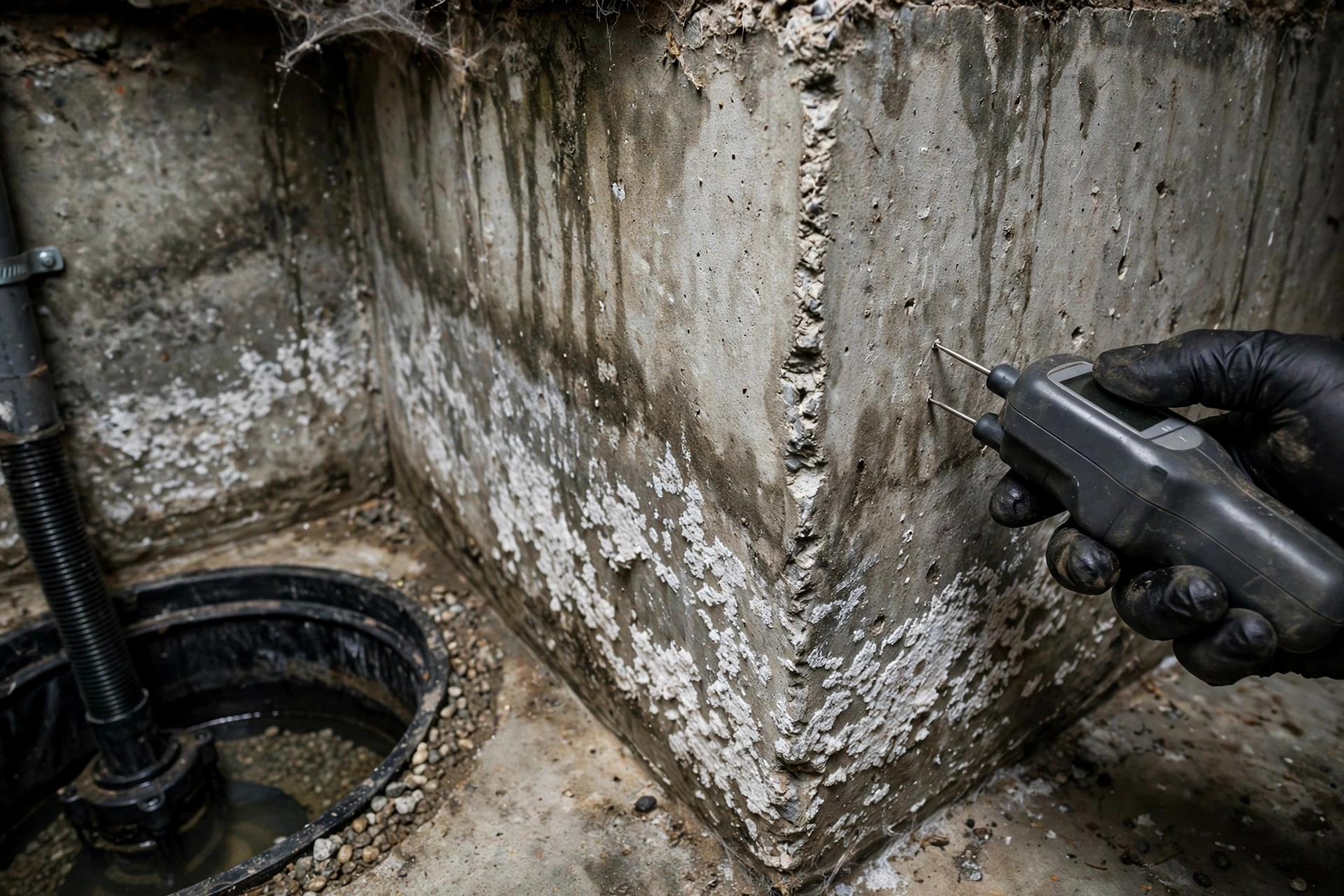
A moisture-first inspection: meters on the wall, the full pathway of the water traced, and written findings with a scope any contractor can be held to.
Real published ranges for Arvada jobs, what actually moves the price, and how to read a quote line by line before you sign one.
Dark growth on chronically wet drywall usually means a long-running leak. Stricter containment, the same S520 process — and no scare tactics.
Burst pipe, flood or sewage backup? The mold clock starts within 24–48 hours of the water. Call now and we will tell you what to do first.
Growth on sheathing and framing from roof leaks, ice dams and bath fans vented into the attic — treated and dried, ventilation corrected.
Our most common Arvada call: snowmelt seepage, dead sump pumps and clay-soil foundation cracks, hiding inside finished basement walls.
Growth on joists and subfloor, fallen insulation replaced, vapor barrier repaired, and the ground-moisture source fixed.
Contamination at the coil, drain pan, air handler and duct lining, assessed as clean-versus-replace — not sold as a generic duct cleaning.
Post-leak, post-flood response: rapid drying inside the 24–48-hour window, then remediation of whatever managed to colonize.
The same protocol at building scale: tenant coordination, after-hours work, and the documentation managers and insurers need.
02 Why Wheat Ridge
Wheat Ridge is Arvada's southern neighbor in Jefferson County, and it grew up differently — a farming community first, which is why larger, semi-rural lots still sit alongside its postwar neighborhoods, and Clear Creek runs through the middle of it. Different above ground. Below ground, Wheat Ridge shares Arvada's housing era and its Pierre Shale — and that is the part mold cares about.
The water arrives the same way: spring snowmelt pressing hydrostatically against foundations, irrigation soaking in along foundation lines on those bigger lots, creek-side ground that stays damp long after the surface looks dry. The bentonite clay in the Pierre Shale swells as it wets — 100 percent or more, per the Colorado Geological Survey — cracking foundations and opening the cove joint where wall meets floor. Growth can start within 24 to 48 hours of a water event, and a finished basement or a quiet crawl space hides it while it spreads.
So mold remediation Wheat Ridge inspections start where the water starts: the foundation line, the sump pit, the low corners of the crawl space. September 2013 is the region's reminder of what this water does at scale — creeks across the corridor left their banks, and the homeowners who flooded then are the ones who learned to watch the melt.
03 What We Hear First
Most first calls from Wheat Ridge start with one of these four moments:
Sump pumps burn out exactly when the melt asks the most of them — and a power outage is the second way the pit loses. From there the clock runs: growth can begin within 24 to 48 hours. We walk through the first hours in our guide to sump pump failure and mold.
A small patch drawing a five-figure bid is the story behind half the quote requests we see. The defence is a written, itemized scope you can read line by line before anyone opens a wall — that is the only kind we write.
It surprises people every spring: a dry climate, a wet basement. The dry air upstairs masks moisture intrusion below grade until the growth is widespread — by the time the smell arrives, the water has usually been there a while.
Bleach, a fan, a coat of paint — and the patch returns by the next melt. Recurrence is the tell: the surface was cleaned and the source was not. Mold is the symptom; water is the problem.
04 Who Calls Us
Four kinds of calls make up most of our Wheat Ridge work:
Original-era homes with finished basements and crawl spaces, sitting on the same shale as Arvada's. The pattern is familiar: fine upstairs, quietly damp below, and a smell that gives it away.
Bigger ground means longer foundation lines, irrigation that soaks in against them, and low corners that drain toward the house. The moisture pathway is longer here — the inspection has to walk all of it.
Mold found in an inspection window stalls deals on both sides of the table. Written findings, a documented scope, and third-party clearance results are what turn a stalled deal back into a negotiation.
Colorado's SB24-094 puts landlords on a 72-hour clock after a tenant's mold notice — containment, the water stopped, HEPA filtration, all of it documented. A mold remediation Wheat Ridge call that ends with a written scope and third-party results is the paper trail that protects everyone.
05 Get Started
Request Inspection Online
Tell us what you are seeing — the smell, the stain, the flooded corner. We will call back with next steps.
Prefer to talk? Call (720) 794-0650.
06 FAQ
The questions Wheat Ridge homeowners ask us most — with the reasoning attached, not just the answer.
Yes. Wheat Ridge is directly south of our base at 5220 Marshall St in Arvada, and mold remediation Wheat Ridge calls are part of our regular route — same crew, same written scope, same third-party clearance testing as any Arvada job.
Start with published figures, not guesses: a typical local job is published at $1,600–$2,900, larger work at $1,500–$4,500 on Atlas Contracting's published range, and inspections at $250–$500. Angi's $2,368 is a national average — labelled national, not a Wheat Ridge quote. Your number depends on the area involved, what has to come out, and whether the water source needs repair; every job starts with a free written, itemized scope so you can judge it line by line.
Growth can begin within 24 to 48 hours of a water event, which is why the first day matters: stop the spread, get standing water out, start drying, and document everything with photos before cleanup — that record is what an insurance claim runs on. A surface can feel dry while wall cavities are still wet, so a moisture reading beats a guess.
No. Colorado does not license mold remediators — CDPHE says plainly that it does not regulate mold — and there is no such thing as an EPA certification for a mold company. What you can check is the work itself: an ANSI/IICRC S520 process, a written itemized scope, and clearance results from a third-party lab.
For a small, contained job, usually yes — the work area is sealed off from the rest of the home either way. For larger jobs or confirmed black mold, 24 to 48 hours away is often the sensible call, especially with kids, older adults, or anyone with breathing issues. We will tell you honestly which side of that line your job falls on before work starts.
The smell, the stain, the flooded corner — whatever brought you here, the next step is a look, a moisture reading, and a written scope you can hold us to.
Free, no-obligation quotes · Written scope before work starts · Third-party lab clearance