— Arvada, Colorado · Sump Pumps & Water Damage
Sump Pump Failure and Mold: What Happens When the Pump Quits
A sump pump rarely dies on a quiet Tuesday. It dies during melt week, under nonstop duty — or the storm that fills your pit knocks the power out with it. Here is what happens next in a finished Arvada basement, what to do in the first hours, and how to make sure one failure is all you ever have.
Standing in water right now? Skip the reading — call (720) 794-0650 and we will talk you through the first moves.
- ANSI/IICRC S520 Process
- Third-Party Lab Results
- Written Scope Before Work Starts
- Free, No-Obligation Quotes
- Local Arvada Team
01 The Failure Modes
Why Does a Sump Pump Quit at the Worst Possible Moment?
A sump pump lives a strange life. It can sit idle for months, then melt season arrives and it is asked to run near-continuously for weeks, cycling water out of the pit as snowmelt and spring storms load the soil around your foundation. That is precisely when pumps die. Motors burn out under peak duty. Float switches stick or foul on pit debris. Check valves that have been failing quietly all winter finally give up — and all of it is usually discovered the same way: the pit is already full.
The second failure mode needs no broken pump at all: the power goes out. The spring storms that saturate the ground and fill the pit fastest are the same ones dropping branches on lines across the northwest metro. A perfectly healthy pump with no electricity is a decoration. Between burnout and blackout, most sump failures we see in Arvada happen inside the same few weeks — the weeks the pump matters most.
02 The Clock
What Happens in the First 24–48 Hours After a Failure?
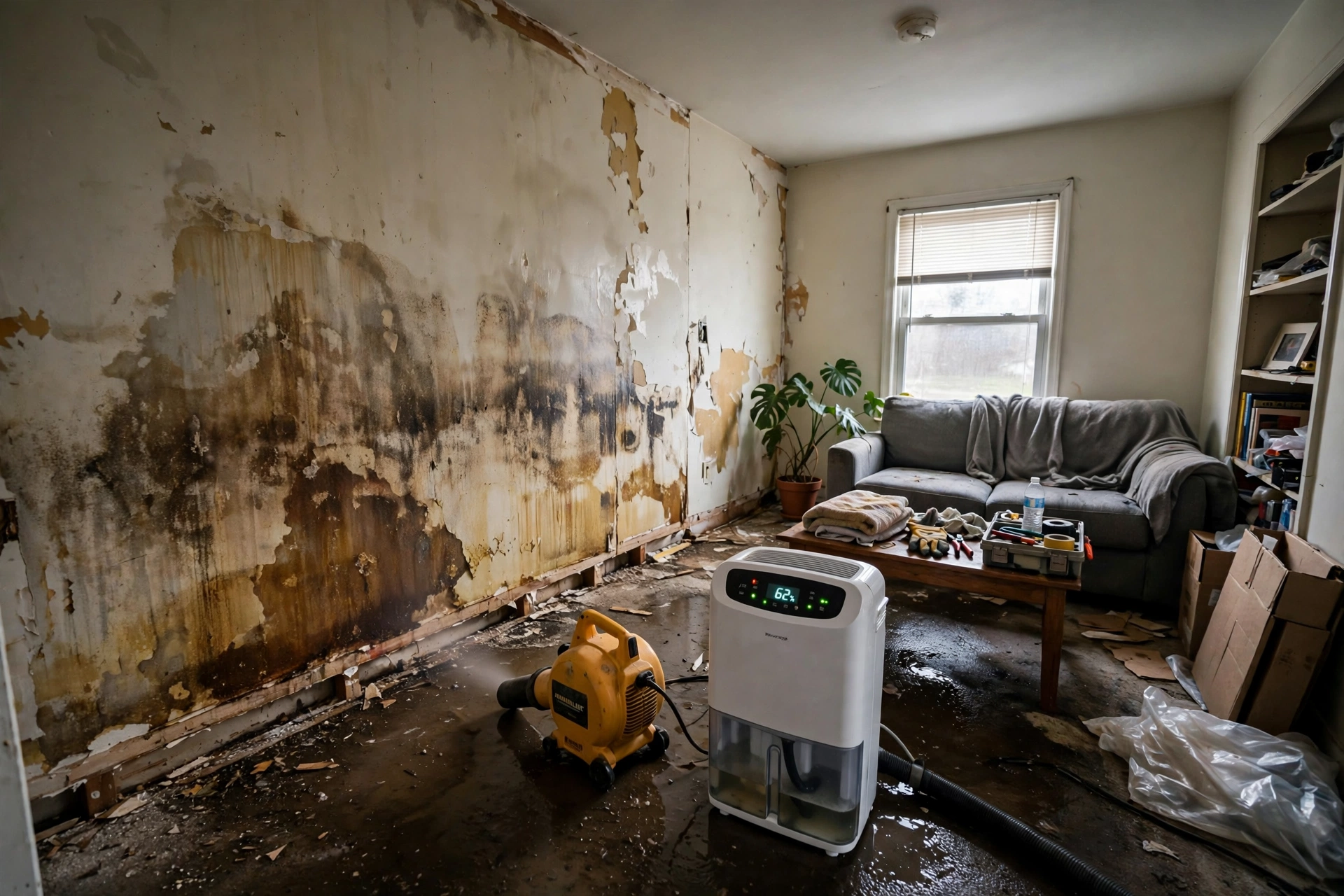
Once the pump stops, the pit fills, and groundwater rises to its level. Water comes over the pit rim and spreads across the slab, wicking into carpet and pad, then into the bottom plate and the drywall behind your baseboards. In a finished basement, almost all of that travel happens where you cannot see it — the room side of the wall can look untouched while the cavity side is soaked.
Then the clock starts. Mold can begin growing within 24 to 48 hours of a water event, and a soaked finished basement hands it everything it needs: paper-faced drywall, insulation, and carpet backing, all holding moisture against warm framing. A failure caught and dried on day one is a cleanup; the same failure found after a long weekend is a removal job. That gap is the territory of mold cleanup after water damage — and, once growth has moved inside the walls, of the basement mold work we do across Arvada. The difference between the two is mostly how fast the water came out.
03 Hour by Hour
What Does the Timeline of a Failure Look Like?
From quiet pit to mold window, the sequence rarely varies:
Read the timeline backwards and it becomes the strategy: everything you do in steps one through three is about never reaching step four.
04 First Moves
Your Pump Just Failed — What Do You Do First?
In order, and the order matters:
- Keep safety first. If water is anywhere near outlets, the electrical panel, or appliances, stay out of it and get help first — water and electricity do not negotiate.
- Stop the spread. Move furniture, boxes, and anything porous up and out of the wet area. Get cardboard off the floor first; it wicks water fastest and feeds mold soonest.
- Get water out and air moving. A wet vac, towels, fans aimed at the base of the walls. Extraction and drying in the first hours is what keeps a failure from becoming a mold job.
- Document before you clean. Photos and video of the pit, the water line on the wall, and anything damaged — dated, and taken before you move things. That record is what an insurance claim runs on.
- Then call us at (720) 794-0650. Tell us how long the pump was down and how far the water got, and we will tell you honestly whether drying is enough or the wall needs to come open.
05 Insurance Reality
Will Insurance Cover a Sump Pump Failure?
Here is the gap we see over and over: a standard homeowners policy usually does not cover sump pump failure on its own. Water that backs up through a sump pit or drain typically requires a separate water-backup endorsement — and many owners have never heard of it until an adjuster explains it, after the fact. If you do not remember buying it, you probably do not have it.
And where mold is covered, it is commonly capped: mold coverage limits frequently run between $1,000 and $10,000, which a finished-basement job can pass quickly. Two habits protect you either way. Check your declarations page for the words "water backup" before melt season, not after a failure. And document any failure with photos before cleanup begins — paperwork is what a claim runs on, and a dry basement with no record is a hard story to tell.
06 Prevention
How Do You Keep It From Happening Again?
Pumps fail in more than one way, so prevention works in layers. A battery backup pump is the layer that covers both failure modes at once: it runs when the main pump burns out, and it runs when the power is out. A water alarm is cheaper and nearly as valuable — it cannot move water, but it tells you the pit is rising while there is still time to act, instead of after the carpet announces it.
Then there is the ten-minute check, best done before the melt: clear debris from the pit, lift the float and confirm the pump cycles, pour in a bucket of water and watch it drain, and confirm the check valve holds so discharged water is not falling straight back into the pit. Most failures announce themselves early to anyone who looks. And because the pump exists to fight the melt, it is worth understanding the water it is fighting — we explain the whole mechanism in our guide to snowmelt basement mold.
One last piece of arithmetic worth doing before spring, not after: the pump is the cheapest part of this whole system. What it protects is not — the bottom edge of finished drywall, baseboards, carpet and pad are all porous, and porous materials that soak through a melt weekend are usually removed, not dried in place. A pump that has already carried several melt seasons has done its work and is living on borrowed time; replacing a tired pump on a calm October afternoon is a different errand entirely from replacing one at midnight in April with water rising around it. If you do not know how old yours is, that is your answer — check it while checking is free.
07 Get Started
Request Inspection Online
Tell us what you are seeing — the smell, the stain, the flooded corner. We will call back with next steps.
Prefer to talk? Call (720) 794-0650.
08 FAQ
Sump Pump Questions
The three questions every Arvada homeowner asks us after a pump failure.
Growth can begin within 24 to 48 hours of the water event. In a finished basement the clock runs hidden — drywall and insulation wick water upward behind the paint while the floor surface looks dry. That is why extraction and drying on the first day matter more than anything you can spray afterward.
Often not under the base policy. Sump failure usually needs a separate water-backup endorsement, which many owners do not have — and even where mold is covered, caps commonly run $1,000 to $10,000. Check your declarations page for 'water backup' before melt season, and document any failure with photos before you clean up; paperwork is what a claim runs on.
Layers, because pumps fail in more than one way. A battery backup covers both burnout and power outages — the two failure modes we see. A water alarm buys you warning while there is still time to act. And a ten-minute check before spring — clear the pit, test the float, confirm the check valve holds — catches the failures that announce themselves early.
Ready to Deal With Your Mold Problem?
The smell, the stain, the flooded corner — whatever brought you here, the next step is a look, a moisture reading, and a written scope you can hold us to.
Free, no-obligation quotes · Written scope before work starts · Third-party lab clearance