— Arvada, Colorado · Basement Mold & Snowmelt
Snowmelt Basement Mold in Arvada: Why Spring Leaks Turn Into Mold
Arvada's mold season does not start with a flood. It starts with a few warm weeks in spring, when the winter's snow lets go all at once and meltwater presses quietly against your foundation — feeding growth behind finished basement walls long before a stain ever shows.
Basement smelling musty since the melt? Call and describe it — we will tell you what we would check first, free.
- ANSI/IICRC S520 Process
- Third-Party Lab Results
- Written Scope Before Work Starts
- Free, No-Obligation Quotes
- Local Arvada Team
01 The Spring Surprise
Why Does Basement Mold Show Up in the Spring?
Every spring we get the same surprised phone call: "We live in Colorado — it is dry here. How do we have mold?" Upstairs, the surprise is fair. Arvada averages about 16.09 inches of precipitation a year (PRISM data), and the air in your living room earns its dry reputation. But mold here does not grow in the living room. It grows below grade, in the one part of the house that spends weeks each spring sitting in wet ground.
The reason is timing. Winter's precipitation does not soak in as it falls — it stacks up as snowpack on your roof, your yard and the alley, then lets go over a few warm weeks. Add spring irrigation start-up on top of the melt, and the soil against your foundation goes from dry to saturated and stays there. That saturated soil is the engine behind most of the basement mold we remove in Arvada — so here is exactly how the mechanism works, where it has happened before, and what to check in your own basement this spring.
02 The Mechanism
How Does Snowmelt Actually Get Into a Basement?
Start with the soil. Much of Arvada sits on Pierre Shale and the bentonite clay weathered out of it. The Colorado Geological Survey documents that these clays can swell 100 percent or more as they absorb water — effectively doubling against your foundation walls. Dry summers shrink the clay back; wet springs heave it forward again. Year after year of that cycle cracks foundation walls, opens floor cracks, and pries apart the cove joint — the seam where the basement wall meets the floor slab.
Then the meltwater arrives with somewhere to go. Water standing in saturated soil presses hydrostatically against the foundation — not a flood, just patient, weeks-long pressure. It finds the cove joint, the cracks the clay opened, the tie holes and pipe penetrations, and it seeps. A seep is slow enough to hide: a few ounces a day behind a finished wall is more than enough to feed a colony.
The entry points we trace most often:
- The cove joint, where wall meets floor — the classic Arvada pathway
- Foundation cracks opened by swelling bentonite clay
- Window wells that fill with melt and drain against the wall
- The sump pit, when melt volume outruns the pump — or the pump quits
03 Step by Step
What Is the Path Meltwater Takes?
Four steps, in the same order, under most of the spring basement jobs we open up:
Because each step is quiet, the whole chain usually completes before anyone notices step one. The first visible sign is often the last step: a smell, a baseboard, a stain — weeks after the water arrived.
04 Local Precedent
Has Arvada Seen This at Full Scale? September 2013
Arvada does not have to imagine where this pathway leads. In September 2013, after days of Front Range rain, Leyden Creek overflowed across Arvada and Ralston Creek breached the Croke Canal. The water took the same below-grade routes it always takes — against foundations, through cove joints and cracks, into basements — just at flood scale, and all at once.
The paperwork tells the size of it: 2013 stands as Jefferson County's top year for National Flood Insurance Program claims, with 63 claims and $854,000 paid. Most spring melt seasons are that same mechanism at a hundredth of the drama — no headlines, no creek in the street, just saturated soil and a foundation doing its best. The lesson of 2013 is not that every melt is a flood. It is that the pathway is real, it is mapped, and it runs straight through the neighborhoods built along those creeks.
06 Where & What to Check
Which Arvada Neighborhoods Should Check First?
Leyden Rock sits in the same watershed that flooded in 2013, and its homes pair finished basements with the area's swelling bentonite soils. Candelas, on the west side, combines those same clays with below-grade living space. Around Lake Arbor and Club Crest, the 1970s and 1980s split-levels put living space half a story closer to the spring water table — and their foundations have had four decades of clay cycles working on the joints. Olde Town originals and the postwar ranches are not exempt either; they simply tend to show the water in unfinished spaces first, where it is easier to catch.
Wherever you live in Arvada, a ten-minute check each spring catches most of this early:
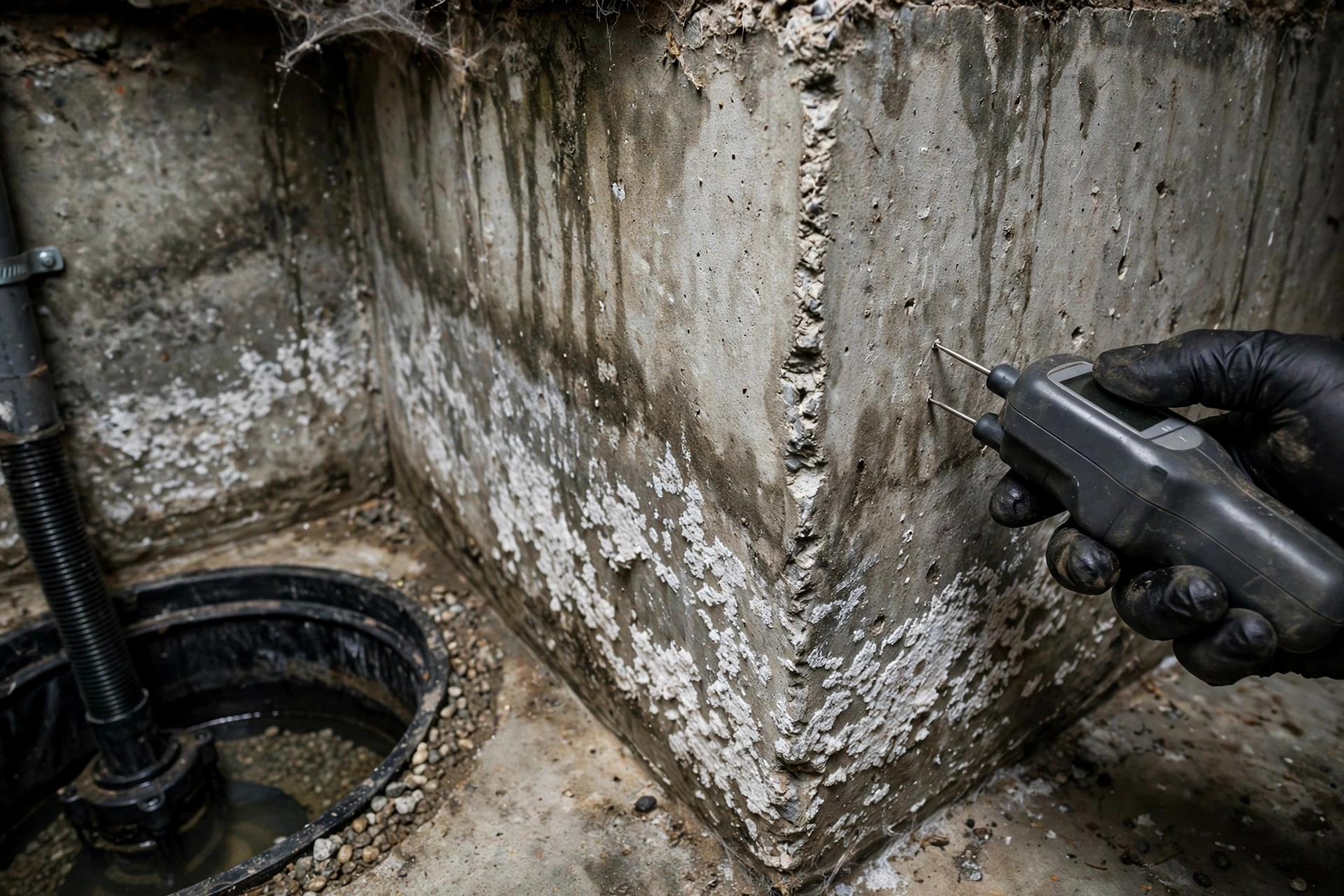
- Run a hand along the base of basement walls — cool, damp drywall is a tell
- Look for white, crusty efflorescence on exposed foundation concrete
- Check the cove joint line for new cracks or dark staining
- Open the sump pit: is the water line normal, and does the pump cycle when you lift the float?
- Sniff at floor level on a warm afternoon — musty at the baseboard means moisture behind it
- Look into window wells for standing water or soil washed against the glass
Find something on that list? The next step is a moisture reading and a look behind the finish before you decide anything. Call us at (720) 794-0650 and we will walk the same checklist with a meter in hand — the inspection and the written scope are free.
07 Get Started
Request Inspection Online
Tell us what you are seeing — the smell, the stain, the flooded corner. We will call back with next steps.
Prefer to talk? Call (720) 794-0650.
08 FAQ
Snowmelt & Basement Questions
The three questions we hear most when the melt starts and the basement smells off.
Because the water arrives all at once. Arvada averages about 16.09 inches of precipitation a year (PRISM), and much of the winter share sits on the ground as snow until melt season, when it soaks in over a few weeks and presses against foundation walls. Upstairs stays dry; below grade, the soil is saturated — and that is where the mold grows.
Yes. Drying stops growth from spreading, but drywall and insulation that stayed wet through the 24–48-hour window are usually colonized inside the wall cavity, where a fan cannot reach. Porous material that grew mold has to come out; framing can normally be cleaned and treated. The smell test helps: if the musty odor survives the drying, something behind the finish is still feeding it.
Fast — growth can begin within 24 to 48 hours of a water event, which is why a spring leak found in May often started as an April seep nobody noticed. The earlier the area is dried and the source stopped, the smaller the job stays.
Ready to Deal With Your Mold Problem?
The smell, the stain, the flooded corner — whatever brought you here, the next step is a look, a moisture reading, and a written scope you can hold us to.
Free, no-obligation quotes · Written scope before work starts · Third-party lab clearance