— Arvada, Colorado · Landlord Guide
Colorado's 72-Hour Mold Rule for Landlords (SB24-094)
If you rent out a home in Arvada, a tenant's mold complaint is not just a maintenance ticket anymore. Since May 2024, Colorado law puts landlords on a 72-hour clock — containment up, water stopped, HEPA filtration running — with the follow-through documented. Here is what the rule actually requires, in plain English.
Tenant just reported mold? Call and tell us the date on their notice — the timeline drives everything that happens next.
- Written Scope Before Work Starts
- Third-Party Lab Clearance
- Documentation That Holds Up
- Local Arvada Team
- Free No-Obligation Quotes
01 The Situation
A Tenant Email Lands. What Happens Next?
Roughly one in four Arvada homes is renter-occupied, and a good share of their landlords are not property companies — they are neighbours. The family that kept its first house in Lake Arbor and rents it out. The couple in West Woods with one inherited ranch. If that sounds like you, this page is written for you, because the law makes no distinction between a one-house landlord and a portfolio.
Before 2024, a mold complaint mostly ran on goodwill and lease language: get to it reasonably soon, keep the tenant reasonably happy. SB24-094 changed the frame. Colorado's warranty of habitability now carries a specific mold protocol with a specific clock, and "we were getting around to it" is not a step in that protocol. We work with Arvada landlords and small property managers through exactly this scramble, usually in the first 48 hours after a notice lands, and the pattern is always the same: the landlords who come out fine are the ones with dates, photos and paperwork.
A plain note before the details: this page is general information about a Colorado law, not legal advice, and we are a remediation crew, not attorneys. For a live dispute or a notice already in hand, a Colorado landlord-tenant attorney is worth the call. What follows is the rule as written, translated into the order things actually have to happen in your rental.
02 The Rule Itself
What Does the 72-Hour Rule Actually Require?
SB24-094 — the "Safe Housing for Residential Tenants" law, effective May 3, 2024 — rewrote Colorado's warranty of habitability at C.R.S. §38-12-503. Subsection (12) is the mold protocol. It starts when a landlord has notice of mold associated with dampness: growth being fed by a leak, seepage, or another water source in the home. From that notice, the clock runs in two stages.
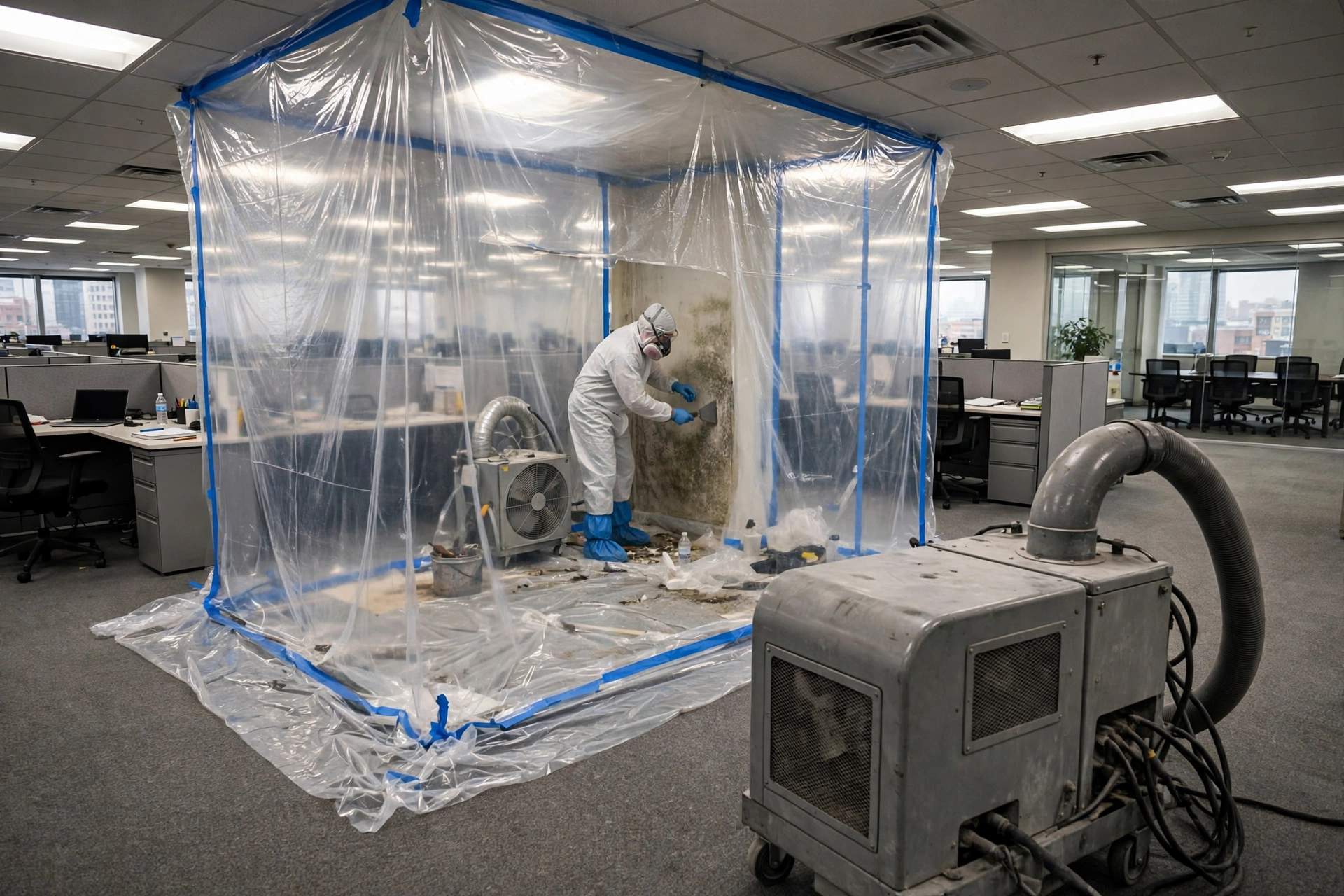
Within 72 hours, three things must be underway: containment installed around the affected area, the active water source stopped, and HEPA air filtration running. Not scheduled, not quoted — underway. There is also an earlier, quieter deadline in the same law: the landlord must contact the tenant within 24 hours of notice with a plan. A tenant who hears nothing for two days is already watching a landlord fall behind the statute.
Then, within a reasonable time, the follow-through: dry the affected materials, decontaminate or remove the damaged ones, and evaluate the remediation — including post-remediation testing — before reassembling the area in a way that keeps the condition from recurring. Read that list again and notice what it describes. Containment, water control, HEPA filtration, drying, removal, testing. The statute does not ask a landlord to dab bleach on a stain; it describes, step for step, a professional remediation.
One boundary worth knowing: the law's definition of an uninhabitable condition covers mold associated with dampness that materially interferes with the tenant's life, health or safety. Minor surface mold on normally wet surfaces — the shower surround that every bathroom grows — is expressly outside that definition. The rule is aimed at moisture-driven growth: the basement wall after snowmelt, the ceiling under a slow roof leak, the bathroom where a supply line has been weeping for months.
03 Enforcement Reality
So Who Enforces It? (Not a Mold Inspector)
Landlords often ask us which agency is going to show up. The honest answer surprises people: there is no Colorado mold inspectorate to show up. Colorado does not license mold remediators, and CDPHE — the state health department — states plainly that it does not regulate mold. Jefferson County Public Health, our local agency here in Arvada, likewise states it has no enforcement authority over mold in housing. No state hotline, no county clipboard, no approved-contractor list.
What a tenant has instead is the law itself. CDPHE points renters toward the warranty of habitability, and Colorado Housing Connects is the resource tenants are directed to for help understanding and asserting their rights. Enforcement runs through that legal channel — notices, demands, and if it ever gets there, a courtroom — not through an inspector's visit. Which is precisely why the paper trail in the next section matters so much: in a process with no inspector, the landlord's own dated records are the evidence of whether the clock was honoured.
It also cuts the other way, and fair landlords should hear it: because no agency pre-approves anyone, a tenant cannot verify your contractor's "state mold license" — there is no such thing, for us or anyone. What a tenant, a mediator or a judge can verify is the work itself: containment in place on day two, the water source fixed, and an independent lab's clearance numbers at the end.
04 The Paper Trail
What Documentation Protects Both Sides?
Five pieces of paper turn a he-said-she-said into a closed file. Together they protect the tenant's health claim and the landlord's wallet at the same time:
- The tenant's written notice, with its date. The clock starts at notice — keep the email or letter that started it.
- Dated photos. Before work, during containment, and after: the condition, the setup, and the finished area, each stamped with when.
- A written scope. What was contained, where the water was coming from, what materials came out, and what was done about the source — in writing, before work starts.
- Invoices and receipts. Proof of what was actually done and paid for, matching the scope.
- Post-remediation testing results from a third-party lab. The statute's own finish line: an evaluation, including testing, by someone other than the crew that did the work.
That documentation-first approach is exactly how we run remediation work for Arvada rental properties and commercial buildings — written scope up front, the moisture source named in it, and third-party clearance results at the end, so your file answers questions before anyone thinks to ask them in a formal letter. Colorado's habitability framework expects repair records kept for three years; keep the whole mold file at least that long.
And if the long-term plan for the property changes — if the rental becomes a sale — the same file follows the house. Colorado's seller disclosure asks about mold history and mold reports directly, which is why we walk through what the SPD19 disclosure means for a home with a mold past in our companion guide. Paperwork written for a tenant dispute turns out to be the paperwork that protects a closing.
05 Local Reality
Why Arvada Rentals Grow Mold in the First Place
The median Arvada home was built in 1979, and most of the rental stock shares the same anatomy: a finished basement over clay soil that swells as it wets, a sump pump of unknown age, and a foundation cove joint that spring snowmelt presses against for weeks. Upstairs stays dry — this is Colorado — while below grade the water does its quiet work behind drywall nobody opens. Tenants usually meet it as a smell first: musty air in the basement bedroom, an odor that cleaning never quite clears.
That timing matters for landlords. Notices cluster in spring, when melt water finds the foundation, and in the weeks after a pipe or water heater lets go. A landlord who walks the basement of each rental every spring — checks the sump pit, looks at the base plates, sniffs the air at the bottom of the stairs — is buying the cheapest insurance in this whole page: finding the moisture before a tenant's email starts a statutory clock on it.
If the email has already landed, do not spend the first of your 72 hours reading about the law. Spend it on the phone: containment and a stopped water source are what the first deadline measures. Call us at (720) 794-0650, tell us the date on the notice, and we will tell you honestly what can be in place by when. And once more, because it matters: everything on this page is general information, not legal advice — for the legal side of a live case, bring in a Colorado landlord-tenant attorney alongside the remediation crew.
06 Get Started
Request Inspection Online
Tell us what you are seeing — the smell, the stain, the flooded corner. We will call back with next steps.
Prefer to talk? Call (720) 794-0650.
07 FAQ
Landlord Questions on the 72-Hour Rule
The questions Arvada landlords ask us in the first phone call after a tenant's notice — answered from the statute and the enforcement reality.
No. The protocol targets mold associated with dampness that materially interferes with the tenant's life, health or safety. Minor surface mold on normally wet surfaces — a shower surround, for instance — sits outside the law's definition of an uninhabitable condition. When the growth is fed by a leak or seepage, though, treat it as covered and document what you found and when.
Nobody with a badge. CDPHE does not regulate mold, and Jefferson County Public Health states it has no enforcement authority over mold in housing. Tenants are pointed to Colorado Housing Connects and to the warranty of habitability itself — meaning enforcement runs through the law and, if it comes to it, the courts. That is exactly why your dated records matter more than any inspection.
Keep the whole file: the tenant's dated notice, your dated photos before, during and after the work, the written scope, invoices, and the post-remediation testing results. Colorado's habitability framework expects repair records to be kept for three years — treat that as the minimum and keep the mold file at least that long.
Ready to Deal With Your Mold Problem?
The smell, the stain, the flooded corner — whatever brought you here, the next step is a look, a moisture reading, and a written scope you can hold us to.
Free, no-obligation quotes · Written scope before work starts · Third-party lab clearance