— Arvada, Colorado · Mold Guides
Attic Mold in Arvada: Ice Dams, Bath Fans, Blocked Vents
Most attic mold we find in Arvada did not come through the roof at all — it rode up from the bathroom below. Add chinook freeze–thaw cycles that dam meltwater under the shingles, and soffit vents buried under insulation, and a dry-climate attic can stay damp enough to grow on the sheathing for years. Here is the honest tour of all three sources, and what that black staining on the wood actually means.
Found staining on attic sheathing during roof work or a home sale? Call and describe it — we will tell you what it means before anyone sells you a scare.
- Written Scope Before Work Starts
- Third-Party Lab Clearance
- Free No-Obligation Quotes
- Local Arvada Team
01 The Space Nobody Opens
Why Does a Dry-Climate Attic Stay Damp?
An attic is where a house exhales — and in Arvada, it is also the space nobody opens between the day they move in and the day a roofer or a home inspector pops the hatch. Moisture reaches it from two directions: warm, wet air rising from the living space below, and water arriving from the roof above. Either one, left alone in a dark, still space, is enough to grow mold on the underside of the roof deck.
The local housing stock stacks the odds. Arvada's median home was built in 1979, and 52.5% of its houses went up before 1980 — an era when venting details that are standard practice now were handled loosely, if at all. Those shortcuts do not announce themselves. They sit above the ceiling for forty years, quietly loading the sheathing with moisture every winter, until a roof replacement or a sale puts eyes on them.
When we trace attic mold back to its source, it resolves into three causes, in roughly the order we find them: bathroom fans venting into the attic instead of out of it, ice dams and roof leaks letting water in from above, and blocked ventilation that keeps the space from ever drying out. Here is each one, plainly.
02 The Source Nobody Writes About
Is Your Bath Fan Venting Into the Attic?
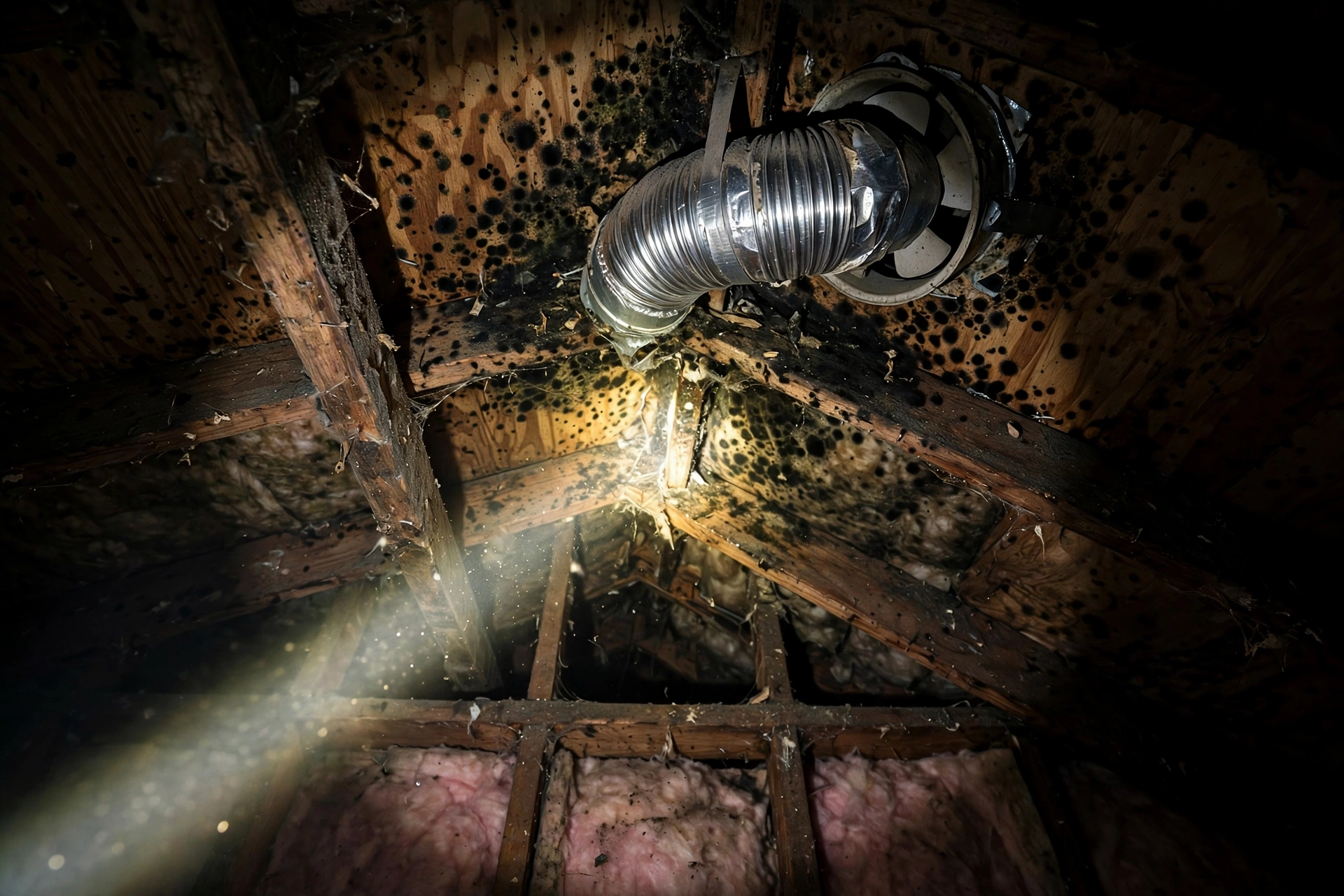
This is the number-one attic moisture source in Arvada, and the one almost nobody writes about: the bathroom exhaust fan that was never ducted through the roof. Instead of carrying shower steam outside, the duct ends in the attic — sometimes loose between the joists, sometimes pointed hopefully at a soffit — and every shower sends a load of warm, saturated air directly onto the underside of the roof deck.
Winter is when it does its damage. The sheathing above a bathroom is some of the coldest wood in the house on a January night, and warm moist air meeting cold wood means condensation, night after night, all season. The staining that results has a fingerprint: it concentrates on the sheathing and rafters above the bathrooms, while the rest of the attic stays comparatively clean. In Arvada's pre-2000 stock — the split-levels of Lake Arbor and Club Crest, the ranches of the older east-side grids — this is not a rare defect. It is an era problem, repeated street after street by the same building habits.
The fix is mechanical, not chemical: the fan gets a real duct, run through the roof to a proper cap, so the steam leaves the house the way it was always supposed to. Until that duct exists, cleaning the sheathing is mopping with the tap running — the growth will be re-fed every time someone takes a hot shower. Source first, then cleanup; that order is the whole game in an attic.
03 Water From Above
How Do Ice Dams Push Meltwater Under Your Shingles?
The Front Range does not do steady winter — it does chinook cycles. A warm spell rolls off the foothills and melts the snowpack sitting on your roof; the meltwater runs down toward the eave, where the roof overhang is cold, and refreezes into a ridge of ice. The next melt has nowhere to go. It ponds behind the dam and backs up under the shingles — a surface designed to shed running water, not to sit submerged — and from there into the attic and the tops of the walls below.
Ice-dam water tends to show at the edges: staining and growth near the eaves and exterior walls rather than mid-span. It also shares the attic with the third source on our list, plain roof leaks — hail-damaged shingles and failed flashing let storm water past the roof covering, and water that gets into an attic or wall cavity can start growing mold within days. A roof-mounted swamp cooler with a leaking pan belongs in this family too; we gave that one its own guide to swamp cooler mold, the Colorado problem nobody mentions.
What ice dams and leaks have in common with the bath fan is that none of them is fixed from inside the attic. The dam is a roof-and-insulation problem, the leak is a roofing problem, the fan is a ducting problem. The attic cleanup is the last step of each, not the first.
04 The Drying System
Can Blocked Soffit Vents Keep an Attic Wet?
Ventilation is the attic's drying system. Cool air is supposed to enter at the soffits along the eaves, sweep up the underside of the deck, and leave at the ridge or roof vents, carrying moisture out with it. That slow conveyor is what lets an attic forgive the occasional wet week — a small leak, a steamy holiday with a house full of guests — instead of storing the water in the wood.
The intake is the fragile part. Soffit vents sit exactly where attic insulation wants to drift, and in older Arvada homes we routinely find the eaves packed tight with insulation that was blown or laid right over the vents, with no baffles to hold it back. The ridge vent may be wide open, but a conveyor with its intake choked moves almost no air. Moist air from the bath fan or a minor ice-dam leak then lingers for weeks instead of clearing in days, and wood that never fully dries is wood that grows.
This is why two houses on the same street, with the same fan mistake, can age so differently: the one with open soffits dries between insults, and the one with buried vents accumulates them. When we look at an attic, the vents get checked alongside the staining — because clearing them is sometimes half the cure.
05 The Honest Read
Black Staining on Sheathing: Disaster, or Just a Stain?
Here is the part where we part company with the scare version of this business. Dark staining on attic sheathing is common in Arvada's older stock, it photographs terribly, and it is routinely presented to homeowners — often mid-sale, when panic is most expensive — as proof of a ruined roof deck. Colour alone proves no such thing. A dark stain does not name a species, and staining by itself is not structural failure.
Sheathing fails when wood stays wet long enough to rot: fibres soften, the panel goes spongy or crumbly, fasteners lose their grip. That is a different finding from surface growth on wood that is still sound, and the two get different answers — one is a carpentry conversation, the other is a cleaning one. We check both the moisture and the wood before we say which attic you have, because telling a homeowner their deck is ruined when it is stained is the same dishonesty as telling them a stain is nothing when the wood is soft.
When growth is active, or the wood is genuinely compromised, the cleanup follows the source fix: containment where the work requires it, removal of growth from sheathing and framing, and wet insulation dealt with where it has been soaked. If your attic is at that stage, here is what our attic mold cleanup involves — and if you are mid-transaction with an inspector's photo in hand, call (720) 794-0650 and describe what you are seeing. The honest read is free.
06 Get Started
Request Inspection Online
Tell us what you are seeing — the smell, the stain, the flooded corner. We will call back with next steps.
Prefer to talk? Call (720) 794-0650.
07 FAQ
Attic Mold Questions, Answered Straight
The questions Arvada homeowners ask us most when an attic hatch comes open — answered short, straight, and with the reasoning attached.
Look in the attic for where the fan's duct ends. It should run to a vent through the roof. If the duct stops loose in the attic, dumps its air near the eave, or there is dark staining on the sheathing directly above the bathroom, the fan is venting indoors. Frost on the tips of roofing nails in winter is another tell — that is indoor moisture condensing on the coldest metal in the space.
Usually not. Staining is often surface growth on wood that is still sound — dark sheathing looks alarming, but colour alone does not name a species or prove damage. Rot is the real failure: wood gone soft, spongy or crumbly after staying wet too long. We check the moisture and the wood itself, and tell you honestly which of the two you are looking at before anyone talks about replacement.
Fixing the source stops the moisture feeding it, and growth on dry wood goes dormant — but it does not disappear, and dormant growth wakes back up the next time the attic gets wet. The order that sticks is source first, then cleanup of the sheathing and framing, so the attic you are left with is both dry and clean. Skipping the cleanup leaves the staining — and the spores — in place for the next wet season.
Ready to Deal With Your Mold Problem?
The smell, the stain, the flooded corner — whatever brought you here, the next step is a look, a moisture reading, and a written scope you can hold us to.
Free, no-obligation quotes · Written scope before work starts · Third-party lab clearance