🚨 Emergency Mold Removal — Serving Arvada & the Northwest Metro (720) 794-0650

— Arvada, Colorado · Mold Guides

Swamp Cooler Mold: The Colorado Problem Nobody Mentions

Drive any older Arvada street in July and you will see them humming on the roofs: evaporative coolers, the Front Range's answer to summer. A swamp cooler is also the one appliance in your home that adds moisture to the air on purpose — and when its pads, reservoir and ducts stay wet, mold moves in and the fan delivers it to every room. Here is how it happens, how to spot it, and the two weekends a year that decide it.

Cooler blowing a musty smell through the house? Call and describe it — we will tell you straight whether it sounds like routine upkeep or a bigger job.

  • Written Scope Before Work Starts
  • Third-Party Lab Clearance
  • Free No-Obligation Quotes
  • Local Arvada Team
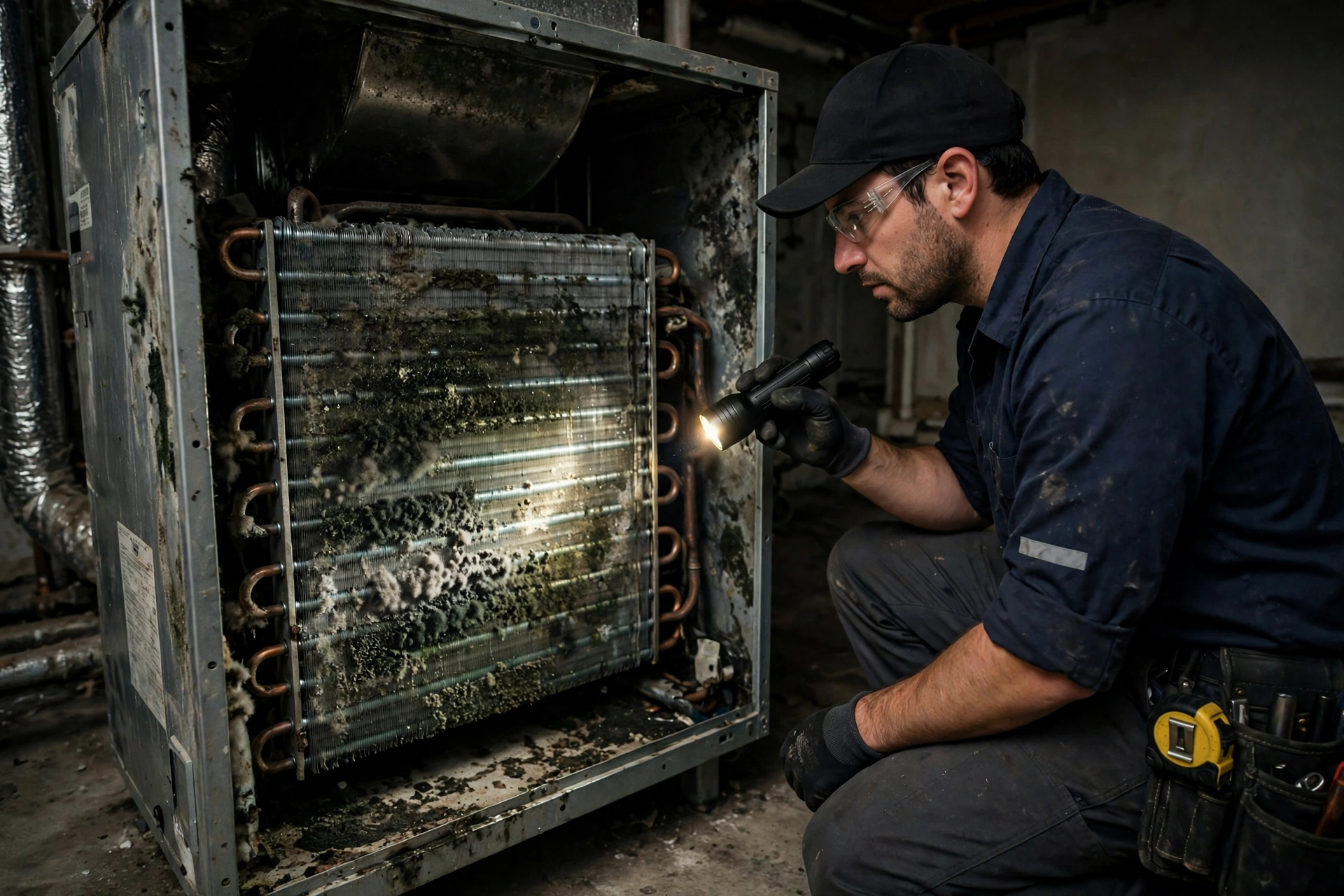
HVAC ductwork and air-handling equipment in an Arvada home, the system a swamp cooler feeds

01 The Local Blind Spot

Mold? In Colorado? Start With the Box on Your Roof

The reaction we hear most in Arvada is some version of disbelief: mold is a swamp-state problem, a basement-in-Louisiana problem — not a problem for a city that sees roughly sixteen inches of precipitation in a year. That disbelief is the top local misconception we run into, and it is understandable. It is also how moisture problems here get a head start: a dry climate masks an indoor moisture problem until it is widespread, because nobody goes looking for one.

Now consider the cooler. Refrigerated air dries a house out; an evaporative cooler does the opposite. It cools by pulling hot outdoor air through water-soaked pads and pushing the humidified air through your ductwork, all summer, by design. In a dry climate that is a genuinely good trade — cheap, simple, effective. But it means the average Arvada home with a cooler has a machine on the roof whose entire job is manufacturing indoor moisture.

When that machine is maintained, the moisture passes through and the story ends. When it is not — when the pads stay saturated with dust and growth, the reservoir never dries, and the ducts downstream stay damp — the cooler stops being a cooling system and becomes a distribution system. We wrote this guide because, as far as our research could find, nobody else in the Arvada area has: swamp-cooler mold is a uniquely Colorado problem, and it deserved its own page.

02 The Mechanism

How Does a Swamp Cooler Grow Mold — and Spread It?

Three parts of the unit stay wet by design, and each one can host growth. The reservoir pan holds standing water all season long. The pads sit saturated for months, collecting the dust and organic debris that every cubic foot of summer air carries in — food and water in one place. And the ductwork downstream receives hour after hour of moisture-laden air, which condenses wherever the duct surface runs cooler than the air inside it.

What makes cooler mold different from a patch under a sink is the fan. A leak grows in one place and stays there until someone finds it. A cooler is plumbed into the home's air supply, so growth in the pads or ducts does not stay in the unit — the system delivers it, room by room, every time the thermostat calls for cooling. Front Range operators describe the same pattern from the house's side: a cooler pushes moist air through the home all summer, quietly raising humidity in upstairs bedrooms, closets and bathrooms, exactly where that moisture then condenses on cooler surfaces.

Roof-mounted units add a second, quieter path. A leaking cooler pan does not announce itself — it soaks the ceiling or the attic below it, slowly, in a part of the house nobody opens for months. If your attic has moisture damage and no obvious roof leak, a cooler pan belongs on the suspect list; we cover the attic's other moisture sources in our guide to attic mold from ice dams, bath fans and blocked vents.

03 What to Watch For

What Are the Signs Your Cooler Is Growing Mold?

Cooler mold rarely introduces itself with a visible colony. It introduces itself like this:

The First-Blast Smell

The season's first startup blows a musty, swampy odor through every vent — the smell of pads and a pan that sat damp since last fall. A faint version that clears in a day is startup dust. A smell that settles in and stays is growth.

A Musty Note Whenever It Runs

The house smells fine with the cooler off and faintly musty with it on. That on-off pattern is the signature of a source inside the air path — the unit, the pads, or the ducts it feeds.

Growth You Can See

Dark spotting on supply vent covers, slime or dark staining on the pads when you open the unit, or a reservoir pan with a filmed, discolored surface. If it is visible at the vents, it has been traveling.

The Smell Cleaning Doesn't Fix

You drained it, scrubbed it, changed the pads — and the odor was back within the week. Growth that survives a thorough cleaning of the unit itself is usually growing somewhere the cleaning never reached: the ductwork.

04 The Control Points

When Does Cooler Maintenance Matter Most? Spring Startup, Fall Shutdown

A swamp cooler has two maintenance moments that matter, and both are about water standing where it should not. Spring startup is the first: drain whatever the winter left in the pan, clean the reservoir, and start the season on clean or fresh pads rather than pads carrying last year's dust and growth. Check the pan and float for the slow leaks that soak ceilings. Then run the unit and stand under a vent — your nose is the first inspection tool, and a clean unit blows neutral air.

Fall shutdown is the one Arvada homeowners skip, and it is the expensive skip. A cooler switched off wet in October sits damp through the entire winter, growing quietly for months, and delivers the results through the vents the following June. The shutdown that prevents it is unglamorous: drain the reservoir completely, let the pads and pan dry fully before the cover goes on, and leave the unit dry until spring.

That rhythm — wet season managed, dry season actually dry — is the whole control strategy, because the cooler is the one mold source in an Arvada home with an off switch. When growth has already moved past the unit, though, maintenance stops being the answer. Mold established through ductwork, or in a ceiling and attic below a leaking pan, is cleanup work: that is the side of the line where our HVAC and duct mold cleanup takes over, scoped in writing before anyone opens a register. If you are not sure which side of the line yours is on, call (720) 794-0650 and describe the smell — we will tell you straight.

Two smaller habits carry the middle of the season. Change or clean the pads on the maker's schedule rather than by smell — by the time pads smell, they have been distributing growth for weeks. And remember what the unit does to the whole house: a cooler cools by adding moisture to indoor air, so during the humid stretches of a wet summer it raises the moisture load everywhere, including the basement below. Run it with the windows cracked the way it was designed to run, and do not ask it to fight a closed-up house. The cooler is manageable precisely because it is mechanical — water in, water out, and nothing left standing in between.
05 Get Started

Request Inspection Online

Tell us what you are seeing — the smell, the stain, the flooded corner. We will call back with next steps.

Prefer to talk? Call (720) 794-0650.

06 FAQ

Swamp Cooler Questions, Answered Straight

The questions Arvada homeowners ask us most about the cooler on the roof — answered short, straight, and with the reasoning attached.

Because something in the unit stayed wet. Pads that went into storage damp, a reservoir that never fully dried, or growth in the pan will perfume the first air of the season — and every run after it. A cleaned, dried unit with sound pads should blow neutral air. If the smell survives a real cleaning, the growth has likely moved past the unit and into the ductwork, where a wipe-down cannot reach it.

Yes — the dry climate is exactly why it gets missed. Outdoor Arvada air is dry, but a cooler adds moisture indoors on purpose, all summer long, and that moisture condenses on the cooler surfaces upstairs. The problem hides inside the unit and the ducts while the weather outside argues it cannot exist, which is how cooler mold gets widespread before anyone looks.

The unit itself is homeowner upkeep: draining the reservoir, drying the pan, and cleaning or replacing pads every spring and fall is normal maintenance, and it prevents most cooler mold. Call us when the growth has spread beyond the unit — through ductwork, into a ceiling or attic below a leaking pan — or when the smell returns right after a thorough cleaning. That is no longer upkeep; it is a cleanup, and we will scope it in writing.

Ready to Deal With Your Mold Problem?

The smell, the stain, the flooded corner — whatever brought you here, the next step is a look, a moisture reading, and a written scope you can hold us to.

Free, no-obligation quotes · Written scope before work starts · Third-party lab clearance